

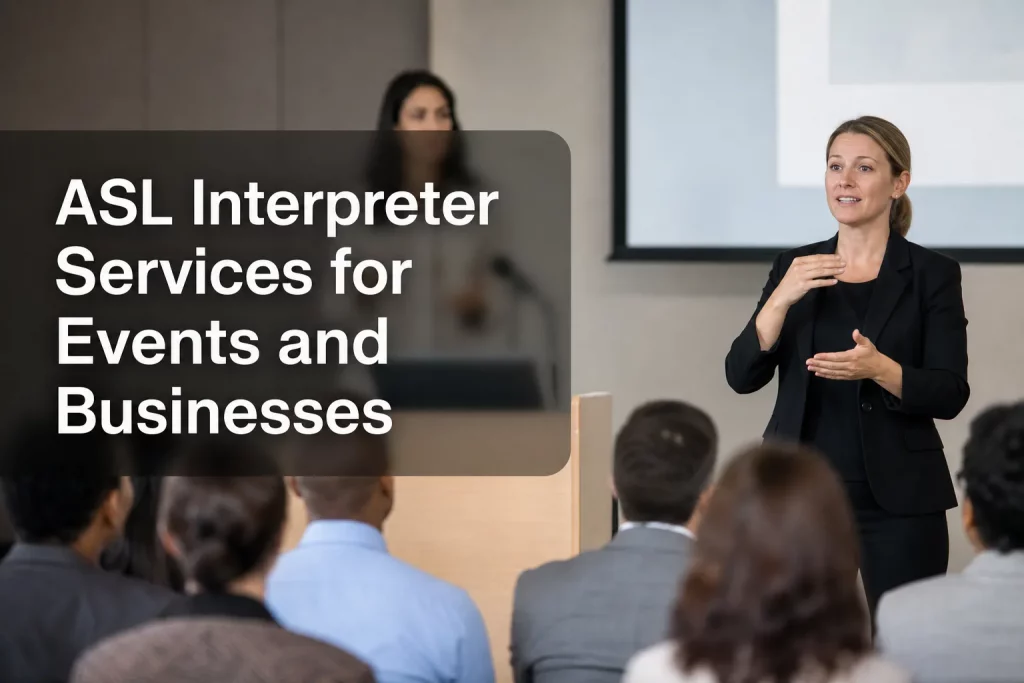
ASL Interpreter Services for Events and Businesses
When you need to make a meeting, event, broadcast, training, or workplace interaction accessible, hiring the right ASL interpreter is not a detail to handle at the last minute. It directly affects communication quality, audience experience, compliance, and brand trust.
For event organizers, corporate teams, churches, trade show producers, and internal communications leaders, the challenge is rarely just finding an interpreter. It is finding the right service model, the right qualifications, and the right support structure for your format, audience, and timeline. That is why many organizations start with a simple search for an ASL interpreter near me, but quickly realize they need broader guidance on planning, accessibility, and execution.
Team Stream helps organizations solve that bigger challenge. With more than 25 years of experience, Team Stream delivers accurate human and AI-powered language support, real-time captioning, interpreting, translation, subtitling, voiceover, and end-to-end event accessibility solutions for live, virtual, and hybrid environments. The result is more than compliance. It is clear communication that works.
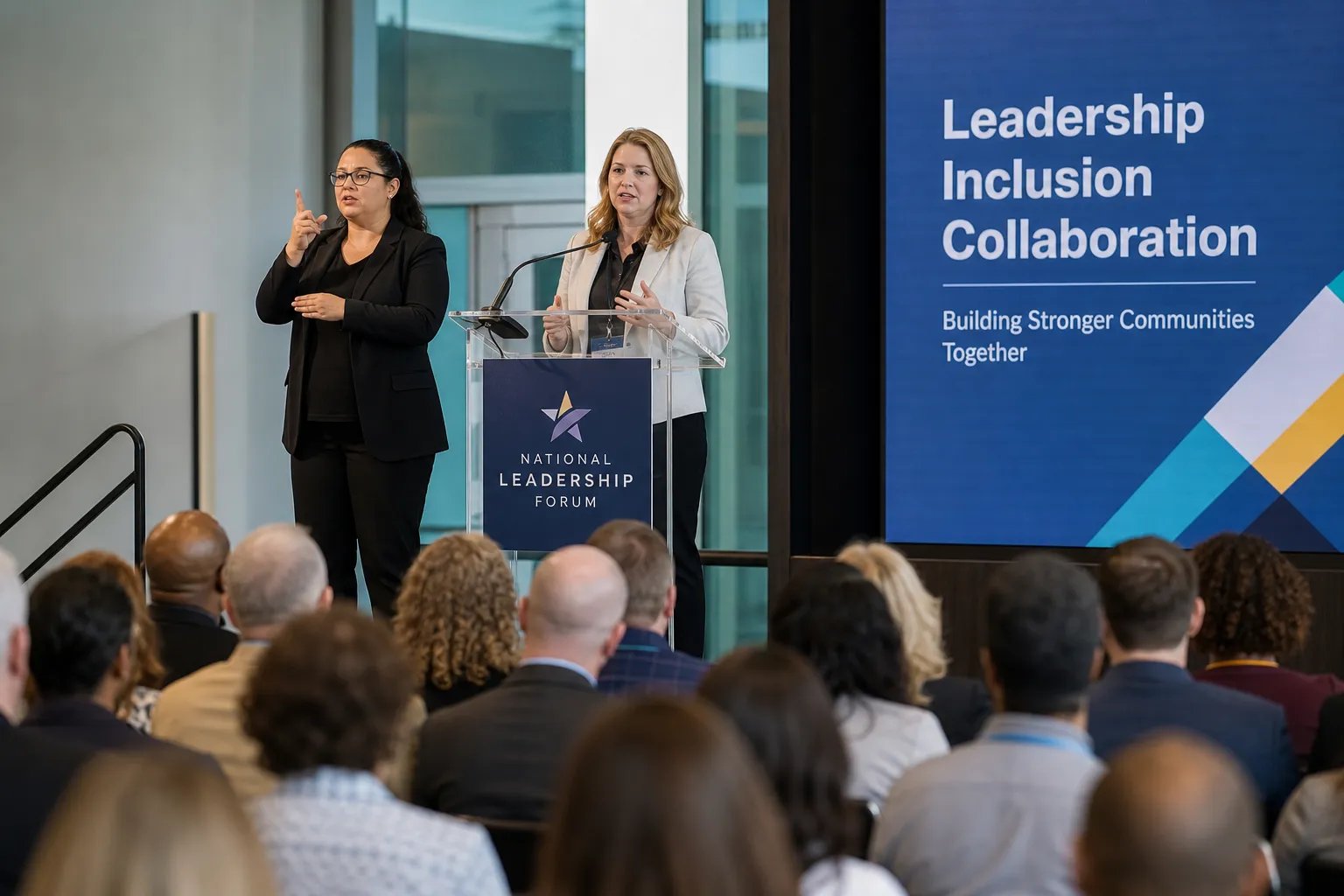
What ASL Interpreter Services Actually Include
Many businesses assume ASL interpreting is a single service. In reality, professional ASL interpreter services can include several delivery formats and layers of support depending on the setting.
On-site interpreting
This is the most familiar format. A qualified interpreter is physically present for the interaction or event. It is often the best choice for:
-
Conferences and keynote sessions
-
Corporate town halls
-
Employee trainings
-
Medical appointments
-
HR meetings
-
Legal and government settings
-
Worship services
-
Trade shows and expos
On-site support is especially valuable when the setting is fast-moving, multi-speaker, highly interactive, or sensitive.
Remote interpreting
Remote delivery can be ideal when speed, geography, or budget matters. This may include scheduled virtual interpreting for:
-
Video meetings
-
Webinars
-
Virtual conferences
-
Remote onboarding
-
Online trainings
-
Telehealth or support calls
A strong provider will not simply assign an interpreter to a video link. They will also help assess platform compatibility, screen layout, interpreter visibility, and audio reliability.
Hybrid event support
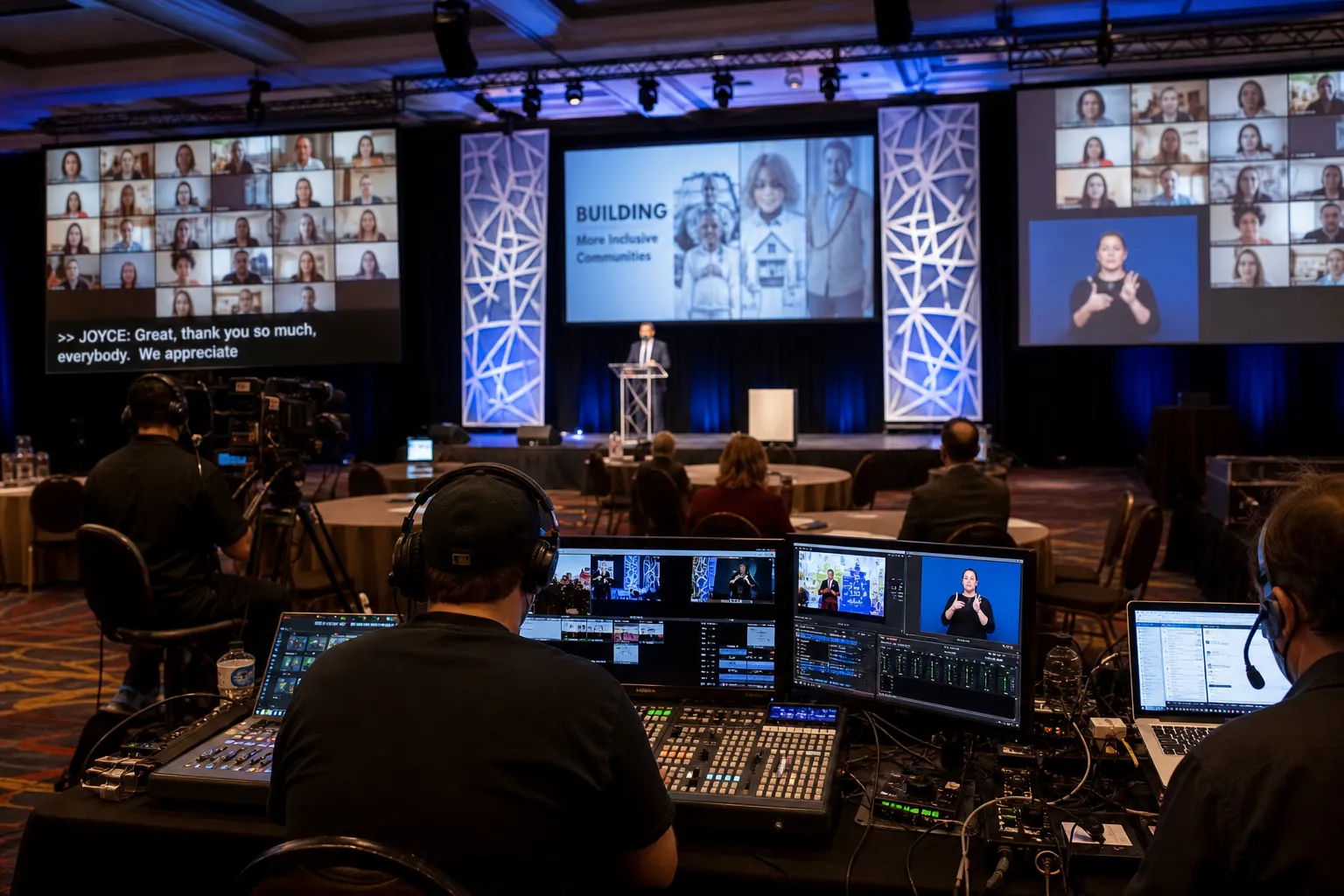
Hybrid events often create the most complexity because the audience experience differs across the room, the livestream, and the recording. In these cases, interpreting should be coordinated alongside:
-
Live captioning
-
Production switching
-
Presentation design
-
Camera framing
-
Stream layouts
-
Post-event captioning or subtitling
This is where Team Stream’s broader accessibility and technical event support becomes particularly valuable. Instead of managing separate vendors for interpreting, captioning, and event logistics, clients can work with one partner that understands how all the pieces interact.
Specialized accessibility services that often belong in the same plan
Competitor pages often focus only on interpreters. What they miss is that many organizations need a more complete accessibility package. Depending on your audience, the right solution may also include:
-
Real-time captioning for live sessions
-
Closed captioning for recorded content
-
Subtitles for multilingual audiences
-
Voiceover for video content
-
Written translation for handouts, signage, or presentations
-
Equipment rental and technician support for live production
-
Remote and in-person service options based on venue or audience needs
When Businesses and Event Teams Need an ASL Interpreter
The need for interpreting is broader than many people realize. It is not limited to large public events or government programs.
Common business use cases
Organizations frequently need interpreters for:
-
Staff meetings
-
New hire orientation
-
Performance reviews
-
Benefits enrollment
-
Safety trainings
-
Compliance briefings
-
Customer-facing events
-
Press conferences
-
Board meetings
-
Community outreach events
If a Deaf or hard-of-hearing employee, attendee, customer, or stakeholder needs access to communication, it is worth planning interpreting early rather than trying to arrange it after the fact.
Common event use cases
Events with interpreting support often include:
-
Conferences
-
Annual meetings
-
Product launches
-
Livestreams
-
Award ceremonies
-
Faith-based gatherings
-
Trade shows
-
Panel discussions
-
Workshops
-
Broadcast productions
The earlier accessibility is built into your run-of-show, the smoother the audience experience will be.
“Approximately 20% of the global population experiences some degree of hearing loss, a figure that is increasing over time.” – WHO
Why “Near Me” Is Only Part of the Decision
Searching for an ASL interpreter near me makes sense if you need local, in-person support. But location alone should not be your main selection criterion.
What matters more than proximity
A strong interpreting partner should be able to answer:
|
What to Evaluate |
Why It Matters |
|---|---|
|
Interpreter qualifications |
Experience and subject matter knowledge affect accuracy |
|
Setting-specific expertise |
Medical, legal, educational, corporate, and stage environments differ significantly |
|
Scheduling responsiveness |
Last-minute gaps can create serious access problems |
|
Team coordination |
Larger events may require multiple interpreters and production planning |
|
Remote capability |
Virtual and hybrid events need platform-specific execution |
|
Accessibility add-ons |
Captioning, subtitling, and technician support may be necessary |
|
Customer service |
Clear communication before and during the event reduces risk |
A local interpreter may be a good fit for a simple meeting. But a regional or national provider with remote options, deep coordination experience, and a broader accessibility stack may be a better fit for an enterprise event or multi-location organization.
What to Look for in a Qualified ASL Interpreting Provider
Not all providers offer the same level of readiness. The strongest agencies do more than fill a booking request.
1. Matching the interpreter to the setting
A medical appointment, executive strategy session, worship service, and televised event all demand different strengths. Quality interpreting depends on assigning the right professional to the right context.
2. Pre-event preparation
Preparation is one of the biggest content gaps in competitor pages. High-performing interpreting is often the result of strong prep, including:
-
Agenda review
-
Speaker names and terminology
-
Slide decks and scripts
-
Brand terms and acronyms
-
Venue layout or platform testing
-
Run-of-show timing
-
Contact protocols for day-of changes
3. Scalability
If your event includes long sessions, multiple rooms, or broadcast elements, you may need more than one interpreter. A qualified provider will advise on team interpreting, rotation timing, and placement strategy.
4. Accessibility beyond interpreting
This is where Team Stream stands out. Many organizations do not just need interpreting. They need a coordinated communication-access plan that may also include:
-
CART or real-time captioning
-
Multilingual translation
-
Subtitling for post-event content
-
Voiceover for distributed media
-
Equipment and technician support
-
Flexible in-person and remote delivery
5. Reliability under pressure
For event producers and operations teams, responsiveness matters as much as credentials. You need a partner that communicates quickly, solves problems, and executes consistently.

On-Site vs Remote ASL Interpreting: Which Is Better?
The right choice depends on risk, audience expectations, format, and budget.
Quick comparison
|
Factor |
On-Site Interpreting |
Remote Interpreting |
|---|---|---|
|
Best for |
Live events, high-touch meetings, complex interaction |
Virtual meetings, quick scheduling, distributed teams |
|
Audience experience |
Strong room presence and natural interaction |
Efficient and flexible when platform setup is done well |
|
Logistics |
Travel, timing, venue coordination |
Tech checks, stable internet, screen layout planning |
|
Scalability |
Ideal for stage and in-room engagement |
Ideal for multi-location and online participation |
|
Budget impact |
May include travel-related costs |
Often efficient for shorter or remote sessions |
A good provider will not push one format for every use case. They will recommend the option that best supports effective communication.
The Role of Captioning Alongside ASL Interpreting
One of the most overlooked planning issues is assuming interpreting alone covers every accessibility need. In many business and event settings, captioning should be considered alongside ASL support.
Why captioning matters too
Captioning can support:
-
Attendees who are hard of hearing but do not use ASL
-
Participants in noisy environments
-
Viewers joining remotely on muted audio
-
Recorded content for later viewing
-
Audience comprehension and retention more broadly
“The ADA requires that public entities provide auxiliary aids and services, such as captioning, to ensure effective communication.” – NCDHHS
Team Stream’s ability to combine interpreting with real-time captioning is especially useful for conferences, corporate broadcasts, worship services, and hybrid events where audiences consume content in different ways.
Planning ASL Support for Live, Virtual, and Hybrid Events
Competitor content usually explains what interpreting is, but not how to plan it operationally. That is where many teams get stuck. Below is a more practical framework.
For live events
Make sure you define:
-
Stage placement and sightlines
-
Interpreter lighting
-
Reserved seating for visibility
-
Session length and interpreter rotation
-
Backstage communication with producers
-
Slides or scripts shared in advance
For virtual events
Confirm:
-
Platform compatibility
-
Whether interpreters will be spotlighted or pinned
-
Screen layout on desktop and mobile
-
Audio routing and delay risk
-
Livestream overlays or interpreter windows
-
Recording strategy if sessions will be repurposed
For hybrid events
Plan for:
-
On-site attendee visibility
-
Virtual attendee visibility
-
Caption integration across both experiences
-
Camera framing for stream output
-
Technician support for switching and layout
-
Post-event editing, captions, and subtitle delivery
This is another area where Team Stream offers unusual value. Because the company supports not only language access but also production-adjacent services like equipment rental, technician support, and flexible event delivery, clients can avoid the fragmentation that often causes accessibility failures.
Mistakes Organizations Make When Booking Interpreters
A lot of preventable issues come from late planning or incomplete assumptions.
Booking too late
The best interpreter match may not be available if you wait until the final days before an event.
Treating all interpreters as interchangeable
Interpreting quality depends heavily on context, subject matter, and environment.
Forgetting the remote audience
For hybrid events, room access does not automatically equal stream access.
Ignoring prep materials
Slides, scripts, names, and terminology dramatically improve interpreter readiness.
Focusing only on compliance
Compliance matters, but the real goal is communication that is clear, respectful, and useful.
Overlooking the value of one integrated partner
Managing separate vendors for ASL, captioning, translations, subtitles, and tech support can create handoff failures. A single experienced partner often produces a smoother outcome.
How Team Stream Delivers Better Accessibility Outcomes
Team Stream is positioned to help organizations go beyond a basic interpreter booking.
End-to-end language and accessibility support
Clients can combine:
-
ASL interpreting
-
Live captioning
-
Closed captioning
-
Subtitling
-
Voiceover
-
Written translation
-
AI-powered language solutions
-
Event equipment rental
-
Technician services
That integrated model is useful for businesses that need accessible communication across meetings, internal communications, marketing videos, worship services, conferences, and broadcasts.
Human expertise plus smart technology
Team Stream combines professional human services with AI-enabled workflows where appropriate. That means clients can scale efficiently without sacrificing quality where precision matters most.
Flexible service delivery
Whether your event is in-person, remote, or hybrid, Team Stream can tailor support to your format rather than forcing a one-size-fits-all package.
Strong service culture
Responsiveness, planning support, and high-quality execution are often what clients remember most. Team Stream’s service model is designed around reliable communication before, during, and after the event.
Experience that reduces risk
With over 25 years of expertise, Team Stream understands the practical realities of event timelines, stakeholder expectations, and accessibility compliance.
A Simple Checklist Before You Book
Before choosing a provider, be ready to answer these questions internally:
|
Question |
Why It Helps |
|---|---|
|
Is the event live, virtual, or hybrid? |
Determines delivery model and technical planning |
|
How many sessions or hours are involved? |
Affects staffing and interpreter rotation |
|
Is the content specialized? |
Helps match the right interpreter experience |
|
Will the session be recorded or streamed? |
May require captions, subtitles, or post-production support |
|
Are there Deaf and hard-of-hearing participants with different needs? |
Interpreting and captioning may both be required |
|
Do you need technical support too? |
Equipment and technician planning may be essential |
The more clearly you define the communication environment, the better your provider can support it.
Final Thoughts
Professional ASL support is not just about checking a box. It is about making sure every participant can fully access communication, contribute confidently, and engage with your content as intended.
If you are looking for ASL interpreter services for a meeting, conference, livestream, church service, training, or workplace interaction, choose a partner that can do more than send an interpreter. Choose one that can help you plan the entire accessibility experience.
Team Stream brings together interpreting, captioning, translation, subtitling, voiceover, technical event support, and responsive customer service in one flexible solution. For organizations that want accessible, compliant, and high-performing communication across live, virtual, and hybrid formats, that makes all the difference.
If your team is ready to create a more inclusive event or business communication strategy, Team Stream is ready to help you execute it with clarity, professionalism, and confidence.
