

Language Interpreter Services vs Apps and Devices
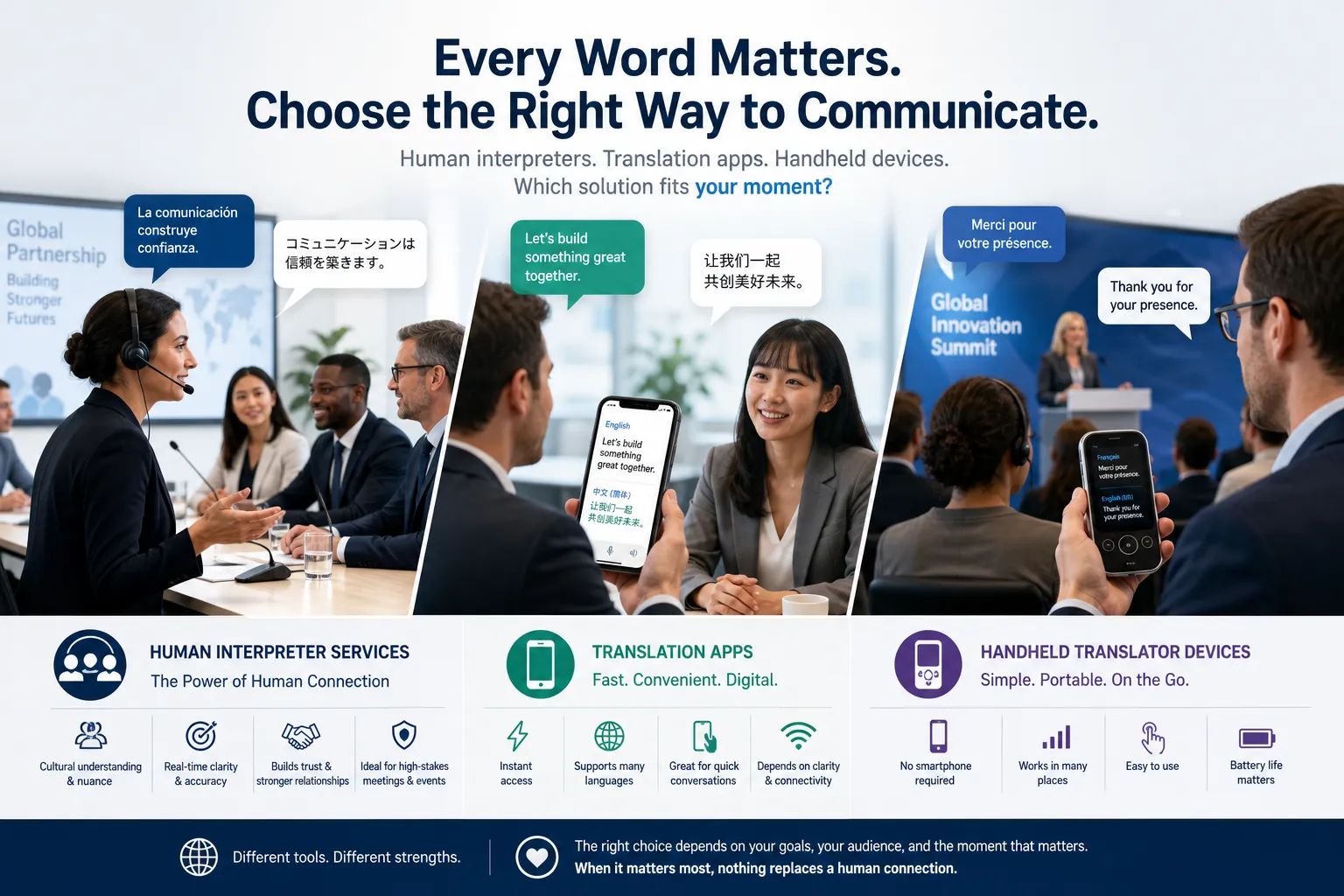
If you are deciding between a professional language interpreter, an app, or a handheld translator device, the right choice depends on what is at stake. For a casual conversation, a text translator app or easy translator tool may be enough. For client meetings, employee training, public-facing events, healthcare communication, legal matters, worship services, and accessible broadcasts, accuracy and accountability matter far more.
That is where many organizations get stuck. They know they need multilingual communication, but they are comparing very different categories: human interpretation, AI-based language interpreter software, online text translator tools, live captioning platforms, and pocket-sized translator hardware. These tools do not solve the same problem in the same way.
This guide breaks down the differences clearly so event organizers, operations leaders, communications teams, churches, conference planners, and businesses can choose the right fit for speed, accuracy, compliance, accessibility, and audience experience. It also explains where Team Stream fits in as a flexible partner offering human and AI-powered language interpreter solutions, captioning, accessibility support, equipment, and experienced technical execution.
The Short Answer: Which Option Is Best?
Here is the simplest version:
-
Use professional interpreter services when the message is important, nuanced, regulated, or public-facing.
-
Use AI interpretation or translation software when you need scale, speed, multilingual access, and budget efficiency for live, virtual, or hybrid events.
-
Use translation apps or devices for low-risk, informal, one-to-one interactions.
-
Use text translation tools only for drafts, quick reference, or internal assistance, not as a final communication method for critical content.
The biggest mistake is treating all of these as interchangeable. They are not.
What Competitor Content Usually Gets Right – and What It Misses
Most top-ranking pages explain what an interpretation app is or promote a single product. They usually highlight convenience, mobile access, and language count. That is useful, but incomplete.
What they often gloss over:
-
The difference between translation and interpretation
-
When human expertise is still essential
-
Where apps fail in noisy, technical, emotional, or regulated settings
-
How captioning and accessibility compliance fit into the decision
-
The role of equipment, technician support, and event execution
-
Why hybrid strategies often outperform one-size-fits-all solutions
That gap matters. If you are planning an investor meeting, a town hall, a trade show keynote, a multilingual church service, or a global training session, you need more than a generic app recommendation. You need the right delivery model.
What Counts as “Language Interpreter Services”?
Language interpreter services help people communicate across languages in real time. That can happen in person, by phone, on video, or through AI-assisted live platforms.
Common formats include:
|
Service Type |
Best For |
Strengths |
Limitations |
|---|---|---|---|
|
In-person interpreting |
Conferences, legal, medical, VIP meetings, live events |
Highest nuance, strong audience trust, handles complexity well |
Higher cost, more logistics |
|
Over-the-phone interpreting |
Customer service, quick support, field communication |
Fast access, scalable, remote-friendly |
No visual cues |
|
Video remote interpreting |
Healthcare, public service, virtual meetings, ASL |
Adds visual context, remote access |
Dependent on bandwidth and setup |
|
AI live interpretation |
Large multilingual meetings and events |
Scalable, fast, cost-efficient, many languages |
Not ideal for all sensitive or high-risk contexts |
|
On-site event interpreting with equipment |
Conferences, summits, broadcasts, worship, trade shows |
Professional audio flow, multilingual attendee experience |
Requires coordination and technical support |
At Team Stream, these formats are not treated as competing products. They are part of a broader toolkit. Some clients need expert human interpreters. Others need real-time AI translation with captions. Many need both, supported by technician services, receiver systems, streaming workflows, and accessibility planning.
Translation vs Interpretation vs Captioning
A lot of confusion starts here.
Translation
Translation usually refers to written content. Examples include brochures, websites, subtitles, contracts, handouts, slide decks, and letters. A letter translator or online text translator may help with a draft, but final business content should still be reviewed professionally when brand reputation or accuracy matters.
Interpretation
Interpretation is spoken communication converted in real time from one language to another. This is what a language interpreter does during meetings, events, calls, and live sessions.
Captioning
Captioning turns speech into on-screen text, often in the same language, though it can also support multilingual access. This is essential for accessibility, audience retention, and compliance.
For many organizations, the real need is not one service in isolation. It is an integrated communication strategy: interpretation for multilingual understanding, captioning for accessibility, and translation for follow-up materials.
Why Human Interpreters Still Matter
Professional interpreters do far more than swap words. They handle tone, context, jargon, pacing, ambiguity, cultural nuance, and audience sensitivity.
“A systematic review published in 2007 concluded that the use of professional medical interpreters is associated with improved clinical care for patients with limited English proficiency.” – PMC / Health Services Research
That finding comes from healthcare, but the principle carries into business, public service, education, and live events: when the stakes rise, trained human support improves outcomes.
Human interpreters are the strongest choice when:
-
A mistake could create legal, financial, safety, or reputational risk
-
The conversation is emotionally sensitive
-
Industry terminology is specialized
-
Speakers have strong accents, talk quickly, or overlap
-
Audience trust and professionalism are critical
-
Confidentiality and accountability must be clear
For organizations that cannot afford miscommunication, human services remain the gold standard.
Where Apps and Devices Shine
Apps and devices are popular for a reason. They are fast, convenient, and often affordable. In the right context, they are useful.
Translation apps work well for:
-
Travel and hospitality basics
-
Simple one-to-one interactions
-
Low-risk frontline exchanges
-
Quick internal clarification
-
Lightweight multilingual support in the field
Translator devices work well for:
-
Staff on the move
-
Retail or service counters
-
Warehouse or logistics teams
-
Situations where a dedicated handheld tool is easier than a phone
The best language translator device is not automatically the best option for business-critical communication. It is simply the best device for a narrow set of fast, practical exchanges.
Where Apps and Devices Start to Break Down
The selling point of a language interpreter app is convenience. The weakness is inconsistency under pressure.
A healthcare study on translation apps found that they could help with basic interactions but also exposed practical limitations around patient replies, accents, context, and usability in real settings. That is a strong reminder that low-risk use is very different from high-stakes use.
Common failure points include:
-
Poor recognition in noisy rooms
-
Confusion with accents or dialects
-
Literal translations that miss meaning
-
Difficulty with technical terminology
-
Weak handling of back-and-forth discussion
-
Security and privacy concerns
-
No event-grade audio routing or audience support
-
No built-in technician oversight
If you are hosting a multilingual keynote, livestream, leadership meeting, or public hearing, “good enough most of the time” is rarely good enough.
Comparing the Main Options Side by Side
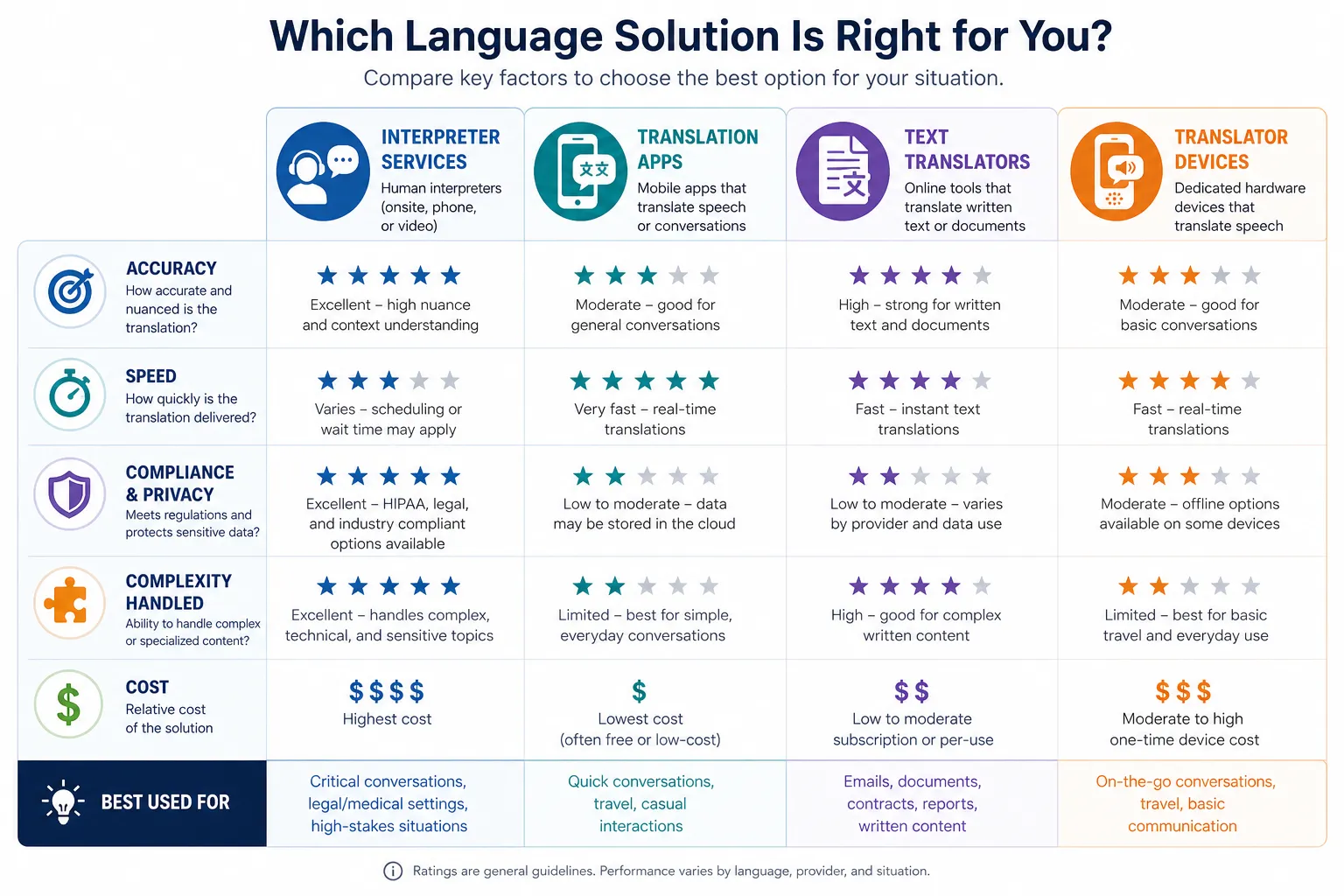
|
Option |
Accuracy |
Speed |
Scalability |
Compliance Readiness |
Best Use Case |
|---|---|---|---|---|---|
|
Human interpreter services |
Very high |
High |
Medium |
Very high |
High-stakes communication |
|
AI interpretation platform |
Medium to high |
Very high |
Very high |
Medium to high |
Large live, virtual, and hybrid events |
|
Phone/video interpreter access |
High |
High |
High |
High |
Support desks, healthcare, public service |
|
Text translator online |
Low to medium |
Very high |
Very high |
Low |
Drafting and informal text reference |
|
Language interpreter device |
Medium |
High |
Low to medium |
Low |
Field use and simple conversations |
|
Text translator app |
Medium |
High |
Medium |
Low |
Casual, low-risk exchanges |
Language Interpretation Companies vs Standalone Software
Many organizations start by searching for language interpretation companies, then compare them to software vendors. That comparison can be misleading because they solve different layers of the problem.
A software-only provider typically offers:
-
A platform
-
Language output
-
Basic admin tools
-
Self-service setup
A full-service language partner typically offers:
-
Human interpreters
-
AI-powered multilingual options
-
Captioning and subtitling
-
Compliance guidance
-
Event workflow planning
-
On-site or remote technicians
-
Equipment rental and audio distribution
-
Translation, voiceover, and post-event assets
That broader model is where Team Stream stands out. Instead of forcing every client into one product, Team Stream builds the right mix of services around the use case.
When to Use Human Interpreting, AI, or a Hybrid Model
Best for Human-Only Support
Choose human interpreters when your session involves:
-
Executive leadership
-
Investor or board communications
-
Legal or compliance-sensitive content
-
Healthcare or patient communication
-
Sensitive HR matters
-
Faith-based pastoral or counseling contexts
-
Press-facing or reputation-critical appearances
Best for AI-Enabled Support
Choose AI-based language interpreter online tools when you need:
-
Multilingual scale at lower cost
-
Dozens of languages at once
-
Live and virtual event support
-
Fast rollout for recurring meetings
-
Captions, transcripts, and multilingual follow-up content
Best for a Hybrid Solution
A hybrid approach is often the smartest option:
-
Human interpreters for keynote sessions or VIP tracks
-
AI interpretation for breakout rooms or large audience access
-
Live captioning for accessibility
-
Written translation for handouts and follow-up
-
Technician and equipment support for seamless delivery
This is often the most practical and cost-effective path for conferences, trade shows, enterprise meetings, and hybrid events.
For Events, the Real Comparison Is Bigger Than “App vs Interpreter”
Competitor pages often frame the choice as “human versus AI.” Event professionals know that is too simplistic.
The real success factors are:
-
Audience access
-
Audio quality
-
Delivery method
-
Screen integration
-
Mobile access
-
Caption visibility
-
Interpreter routing
-
On-site troubleshooting
-
Post-event assets
-
Accessibility compliance
That is why Team Stream’s end-to-end approach matters. The company does not just provide language interpreters. It supports the full communication environment: interpreters, AI solutions, captioning, subtitling, voiceover, equipment rental, technician services, and delivery across live, virtual, and hybrid formats.
How Accessibility Changes the Decision
Accessibility is not a nice extra. For many organizations, it is a legal, ethical, and audience experience requirement.
“Integrating accessibility features like closed captions and audio descriptions into TV advertisements can enhance ad performance, leading to an 8% increase in recall and an 18% boost in brand linkage.” – TV Technology
That same logic applies to meetings, webinars, livestreams, conferences, and internal communications. Accessible content is easier to follow, easier to retain, and more inclusive.
Accessibility considerations include:
-
Live captioning for deaf and hard-of-hearing audiences
-
Clear language access for multilingual participants
-
ADA-conscious and compliance-friendly delivery planning
-
Subtitles and transcripts for replay value
-
Inclusive design for in-person and hybrid experiences
Team Stream’s strength is that accessibility is built into the service conversation, not bolted on at the end.
What About Language Line, Apps, and Online Interpreter Portals?
Some buyers are familiar with major market names like LanguageLine or search for terms tied to a language line interpreter, login access, or interpreter portal workflows. Those services can be useful, especially for quick remote access in customer service or healthcare-style environments.
What matters is not the brand name alone, but whether the delivery model fits your use case.
For example:
-
A call-center style service may work for urgent one-to-one support
-
A personal interpreter service may help individual users
-
A portal-based remote model may support decentralized teams
-
But those tools may not be enough for conferences, broadcasts, multilingual worship, or branded business events
If you need polished execution, attendee experience, equipment coordination, and accessibility support, a broader provider like Team Stream often delivers more value than a single-channel solution.
Screenshot Examples of Common Provider Approaches
Website example: traditional interpreting provider
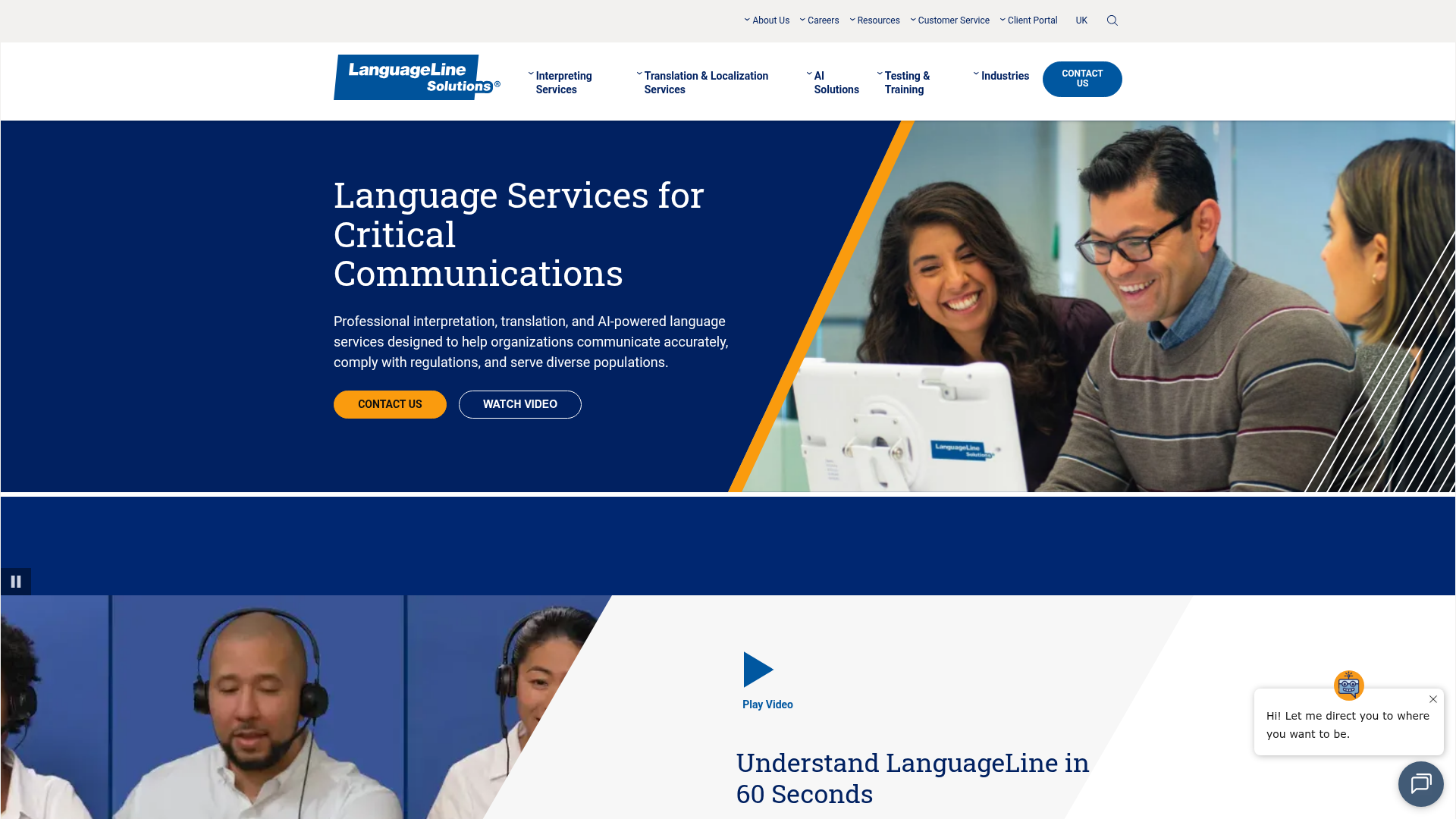
Traditional providers often focus on rapid interpreter access, phone and video workflows, and enterprise deployment. That is valuable for many operational environments.
Website example: AI-first event translation platform
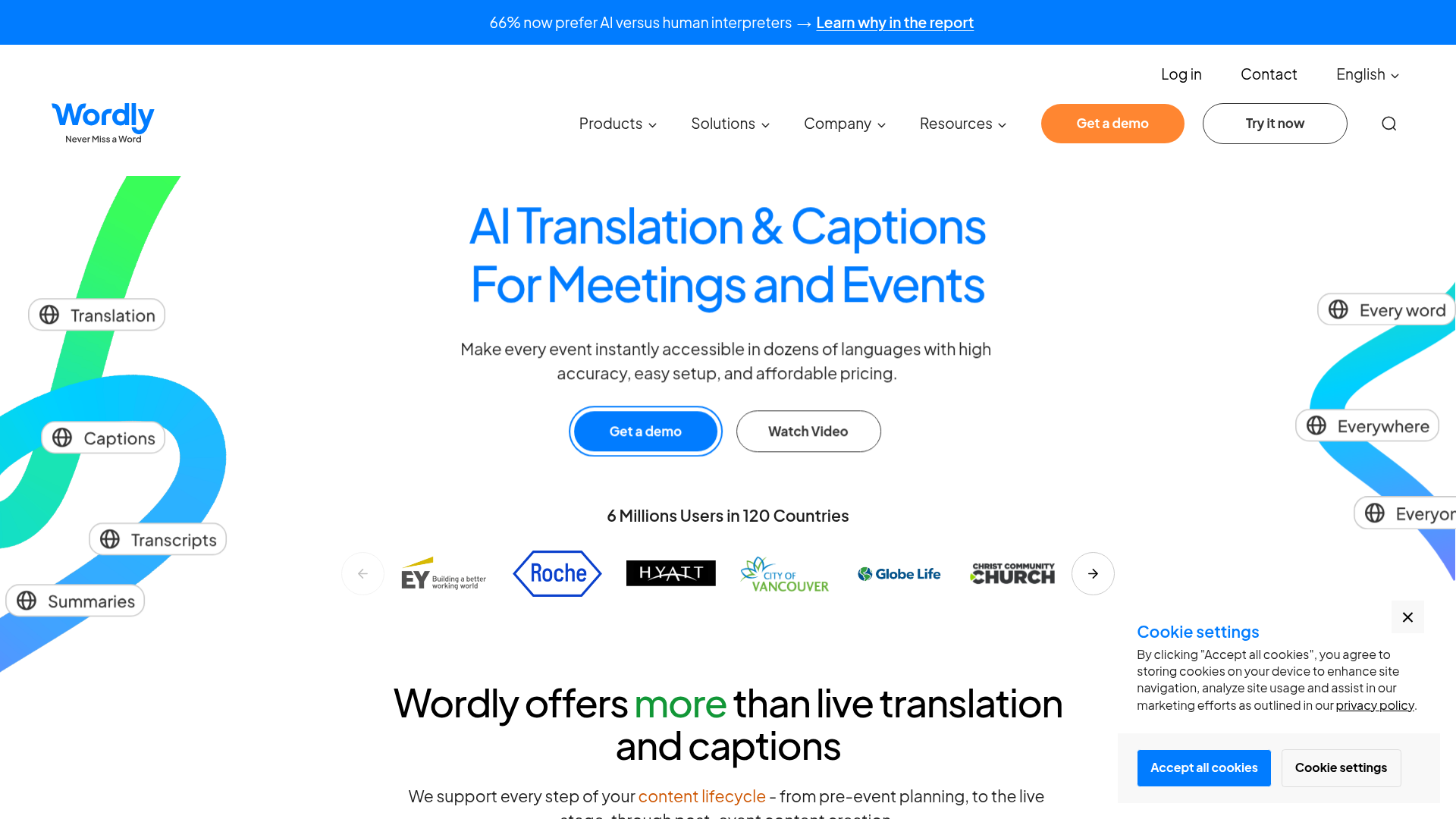
AI-first platforms often emphasize scalability, live translation, and attendee self-service on personal devices. That can be highly effective for event access at scale.
Team Stream sits in a different and often more valuable position: combining both service depth and technology flexibility.
How Businesses Should Choose the Best Fit
Here is a practical framework.
1. Start with risk level
Ask: what happens if the translation is wrong?
-
Minor inconvenience: app or device may be fine
-
Major confusion: use AI with oversight
-
Serious consequences: use human interpreters
2. Define the format
Ask: where will communication happen?
-
One-on-one
-
Meeting room
-
Livestream
-
Main stage
-
Trade show floor
-
Worship service
-
Broadcast studio
Format affects everything from audio routing to caption display to language distribution.
3. Consider accessibility and compliance
Ask: do you need captions, transcripts, ADA-conscious support, or multilingual equity across audiences?
If yes, choose a provider that can handle both language access and accessibility holistically.
4. Map the scale
Ask: how many people, how many languages, how many sessions?
An app might handle one person. A conference may need dozens of simultaneous delivery paths.
5. Look beyond software
Ask: who will troubleshoot if something fails live?
For events, software alone is not enough. Experienced technicians and responsive support can be the difference between smooth delivery and audience frustration.
Best Use Cases by Scenario
|
Scenario |
Best Fit |
|---|---|
|
International conference keynote |
Human interpreters or hybrid with event equipment |
|
Virtual all-hands meeting |
AI interpretation plus live captioning |
|
Trade show booth conversations |
Translator device or app for simple exchanges |
|
Employee onboarding across regions |
AI interpretation, captions, translated materials |
|
Legal or HR investigation |
Human interpreter services |
|
Church service with multilingual congregation |
Live interpreting plus captioning/subtitles |
|
Customer support line |
Phone or video interpreter service |
|
Broadcast or livestream production |
Captioning, interpreting, technician-led workflow |
Why Team Stream Is a Stronger Long-Term Partner
The real value is not just picking a tool. It is building a repeatable language access strategy that works across events, meetings, video, and public communication.
Team Stream brings together:
-
Human and AI-powered language services
-
Real-time captioning for accessibility and engagement
-
Translation, subtitling, and voiceover
-
Support for live, virtual, and hybrid events
-
Compliance-friendly communication planning
-
Equipment rental, sales, and technician support
-
Flexible remote and in-person delivery
-
More than 25 years of experience
-
Responsive, high-quality customer service
That mix is especially valuable for organizations that do not want to manage multiple vendors for interpreting, captioning, accessibility, and event execution.
Final Verdict
If your goal is simple phrase exchange, a language translator app, online text translator, or handheld device may be enough. If your goal is trusted communication, audience inclusion, and professional delivery, interpreter services remain the better choice.
For most businesses and event organizers, the smartest answer is not choosing one side forever. It is choosing the right level of support for each context. Human expertise for nuance and risk. AI for scale and speed. Captioning for accessibility. Technical support for flawless execution.
That is exactly where Team Stream delivers the most value: not as a one-size-fits-all tool, but as a strategic partner for multilingual and accessible communication.
If you need your next meeting, event, broadcast, or worship service to be clear, inclusive, and professionally executed, Team Stream can help you design the right combination of interpreting, translation, captioning, and support services from the start.
FAQ
Is it better to use an app or translator device?
It depends on the situation. For simple, low-risk conversations, an app or handheld device can work well, but for important meetings, events, or sensitive communication, professional interpreter services are usually the better choice.
What are the different types of interpreter services?
The main types are in-person interpreting, phone interpreting, video remote interpreting, and AI-supported live interpretation. Many organizations also combine these with captioning, translation, and technical event support.
What are the three types of translator software?
A practical way to group them is into text translation tools, real-time interpretation software, and captioning/subtitling platforms. Each serves a different purpose, and they should not be treated as interchangeable.
When should interpreter services be used?
Use interpreter services when communication is high-stakes, live, nuanced, regulated, or audience-facing. They are especially important for conferences, healthcare, legal, HR, government, worship, and executive communications.
Is ChatGPT a better translator than Google Translate?
Each tool has strengths, but neither should automatically replace a professional interpreter or translator for critical communication. AI tools can help with drafts or quick understanding, while high-risk situations still call for human review or live interpreting support.
What are the disadvantages of apps?
Apps can struggle with accents, noise, context, technical vocabulary, privacy, and back-and-forth conversation. They are useful tools, but they are not always reliable enough for important business, accessibility, or compliance-sensitive communication.
