

Translate Polish to English: Best Tools in 2026
If you need to translate Polish to English in 2026, the biggest challenge is not finding a tool. It is choosing the right one for the situation.
A student reading a Polish article, a marketing team localizing product copy, a church sharing multilingual messages, and an event organizer handling live Polish-speaking guests all need different kinds of translation support. Some people just want a quick answer from Google. Others need to translate Polish to English speech in real time, preserve tone, or make a meeting accessible and compliant.
This guide compares the best options, explains when automated translation is enough, and shows when professional language support is the smarter choice.
“A 2023 survey by Common Sense Advisory revealed that 85% of global businesses incorporate machine translation into their daily activities.” – Common Sense Advisory
“A 2026 survey found that nearly half of U.S. viewers regularly watch videos with captions.” – TV Technology
Why people search for Polish-to-English translation tools
Polish and English differ in sentence structure, formality, grammar, and idioms. That means even strong AI tools can produce awkward or misleading results if the source text is specialized, informal, or spoken quickly.
Most users fall into one of these groups:
-
People who need fast everyday translation for messages, websites, or directions
-
Professionals comparing tools like Google Translate, QuillBot, and SYSTRAN
-
Teams that need to translate Polish to English speech during meetings, webinars, or events
-
Organizations that need accurate, inclusive communication with accessibility support
-
Businesses that need polished translation for customer-facing materials
That last category is where many “free translator” articles stop short. They review tools, but they do not explain the operational reality: once translation affects customers, compliance, accessibility, or brand trust, raw machine output is only part of the solution.
What competitor pages get right – and what they miss
The leading pages from QuillBot, SYSTRAN, and comparison-style roundups all emphasize a few points:
-
Translation is fast and often free
-
Most tools support many languages
-
AI has improved contextual understanding
-
Some platforms offer voice or document translation
Those are valid selling points. But they usually gloss over the issues that matter most in real use:
Content gaps most articles miss
1. Spoken translation is a different problem from text translation
Typing a sentence into a box is easy. Live speech introduces accents, speed, background noise, interruptions, and the need for immediate clarity.
2. Accessibility is rarely discussed
Many organizations do not just need translation. They also need live captions, subtitles, or multilingual access for attendees who are deaf, hard of hearing, or non-native English speakers.
3. Business risk is understated
A free tool can be fine for casual use, but errors in legal, medical, internal HR, or event communication can create confusion, reputational damage, or compliance issues.
4. Most reviews ignore delivery
Translation is not always just a website. Sometimes you need interpreters, captioners, equipment, technicians, remote support, or hybrid event workflows.
5. Human review still matters
Even strong AI can miss nuance, sarcasm, brand voice, regional phrasing, or sector-specific terminology.
That is why the best answer is rarely “human or AI.” It is usually the right mix of both.
How to choose the right Polish-to-English translation method
Before comparing tools, it helps to match the method to the task.
|
Use case |
Best option |
Why |
|---|---|---|
|
Quick phrases, travel, casual chat |
Google Translate or similar |
Fast and free |
|
Emails, basic business text |
AI translation with review |
Good speed-quality balance |
|
Marketing, brand-sensitive copy |
Human translator or AI + editor |
Tone and nuance matter |
|
Contracts, compliance, medical text |
Professional human translation |
Accuracy is critical |
|
Live meetings or conferences |
Professional interpreters + captions |
Real-time clarity and accessibility |
|
Hybrid or virtual events |
Team Stream end-to-end support |
Language access, captions, technicians, equipment |
Best tools to translate Polish to English in 2026
1. Google Translate
Google remains the default for people who want to translate Polish to English quickly, especially on mobile or in a browser.
Best for
-
Everyday phrases
-
Basic web browsing
-
Travel situations
-
Quick comprehension
Strengths
-
Free and widely available
-
Fast text input and voice features
-
Useful if you want to translate Polish to English speech on the go
-
Broad language coverage
-
Simple mobile experience
Limits
-
Can flatten nuance and tone
-
Weak for specialized content
-
Output may sound literal or unnatural
-
Not ideal for public-facing or high-stakes communication
Verdict
If your goal is speed and convenience, translating Polish to English with Google is still practical. But if the content affects customers, attendees, or decision-making, it should not be your final layer of quality control.
2. QuillBot Translator
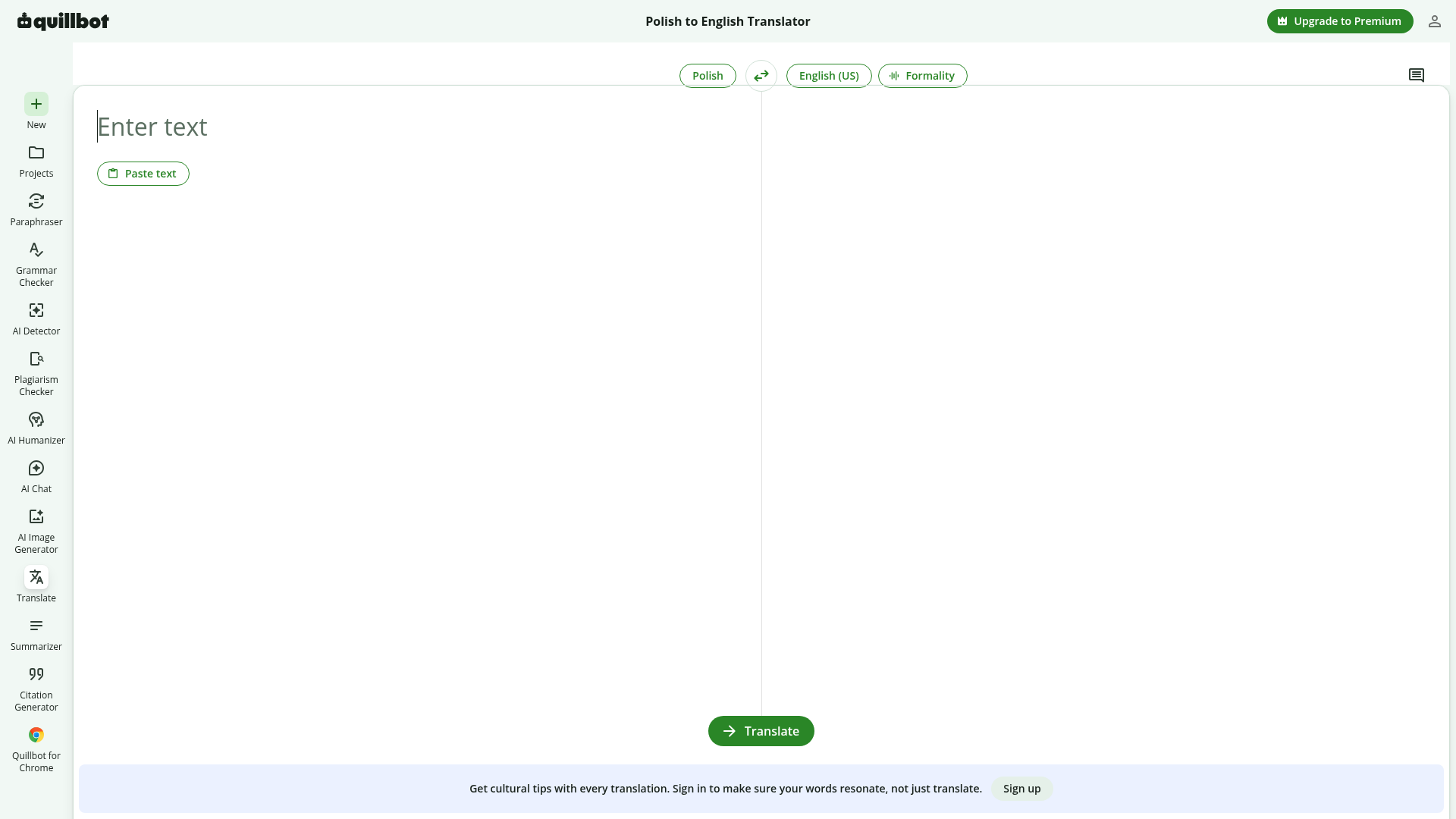
QuillBot positions itself as a user-friendly AI translator for text, phrases, and documents, with extra writing tools around the translation workflow.
Best for
-
Students
-
Writers
-
Light business use
-
Users who want to refine translated wording
Strengths
-
Clean interface
-
Helpful for short-form text and editing
-
Integrates with other writing tools
-
Free tier for moderate use
Limits
-
Better for text than for live spoken language
-
Not a full event or interpreting solution
-
Limited value when you need accessibility workflows or production support
Verdict
QuillBot is useful for drafted content and educational use, but it is not built for live multilingual communication.
3. SYSTRAN
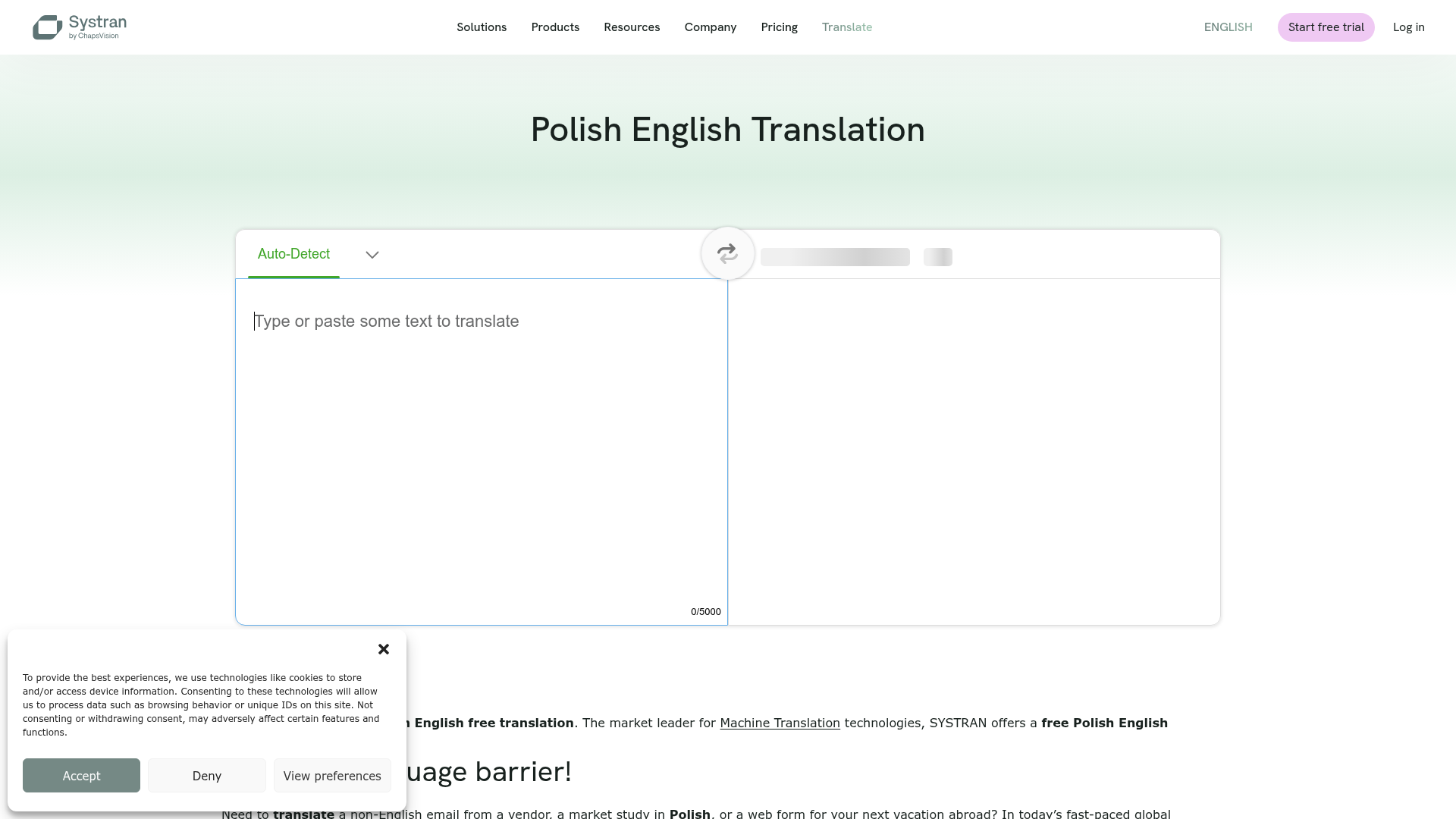
SYSTRAN has a long history in machine translation and appeals more to enterprise users than casual consumers.
Best for
-
Enterprises
-
Teams needing document translation
-
Organizations considering scalable machine translation
Strengths
-
Established machine translation provider
-
Stronger business positioning than many free tools
-
Supports document workflows and larger-scale usage
Limits
-
Less intuitive for casual users
-
Still needs human oversight for nuanced communication
-
Does not solve the broader event accessibility stack by itself
Verdict
SYSTRAN is more serious than a basic free translator, but most organizations still need review, localization judgment, and delivery support around the translation itself.
4. ChatGPT and other LLM-based translators
Large language models can be strong for context, tone, and rewriting rough translation into more natural English.
Best for
-
Draft refinement
-
Tone-sensitive messaging
-
Summarizing and rephrasing
-
Internal working documents
Strengths
-
Better contextual understanding than many older engines
-
Can explain wording choices
-
Helpful for rewriting stiff machine translation into smoother English
Limits
-
Not designed as a dedicated live interpreting platform
-
May hallucinate or over-paraphrase
-
Inconsistent terminology if prompts are weak
-
Not enough on its own for regulated or live audience-facing communication
Verdict
LLMs are powerful assistants, but they work best when supervised. They are not a substitute for professional interpreters, captioners, or translators in high-visibility settings.
5. Professional translation and interpreting services
This is the category many comparison articles underplay. When communication has to be accurate, inclusive, and reliable in real time, services matter more than software alone.
Best for
-
Conferences and events
-
Executive meetings
-
Broadcasts and livestreams
-
Corporate communications
-
Compliance-sensitive content
-
Faith-based gatherings and community outreach
Strengths
-
Human accuracy and nuance
-
Adaptation for audience, tone, and industry
-
Real-time interpreting
-
Live captions and subtitling
-
Accessibility support
-
Flexible remote, on-site, virtual, and hybrid delivery
Limits
-
Higher investment than self-serve tools
-
Requires planning and coordination
Verdict
For anything public-facing, multilingual, or mission-critical, professional support is the most dependable option.
Where Team Stream fits in
Team Stream stands out because it does not force clients into an either-or choice between human and AI. It helps organizations use both intelligently.
If you are planning a multilingual meeting, conference, trade show, church service, webcast, or hybrid event, Team Stream provides:
-
Accurate human and AI-powered translation and interpreting
-
Real-time captioning for accessibility and engagement
-
Written translation, subtitling, and voiceover
-
Support for live, virtual, and hybrid events
-
Compliance-friendly language access solutions
-
Equipment rental and technician support
-
In-person and remote service delivery
-
Responsive customer service backed by more than 25 years of experience
That combination is especially valuable when your challenge is not just to translate Polish to English, but to make communication seamless for everyone in the room or online.
Can you translate Polish to English speech accurately?
Yes, but accuracy depends on context.
If you want to translate Polish to English speech for a casual conversation, mobile apps and browser tools can help. If you need spoken translation for a presentation, executive session, worship service, or audience Q&A, the standard rises dramatically.
What affects speech translation quality
-
Accent and dialect
-
Audio quality
-
Background noise
-
Speed of delivery
-
Overlapping speakers
-
Technical or industry-specific terms
-
Names, places, and cultural references
When AI speech translation works well
-
Basic one-on-one conversations
-
Travel and hospitality situations
-
Low-risk informational exchanges
When you need professional support
-
Live events
-
Board meetings
-
Training sessions
-
Legal or medical discussions
-
Broadcast or recorded content
-
Accessibility-required environments
In these settings, Team Stream can combine interpreting, captioning, and technical support so the audience gets clear, inclusive communication rather than a best-effort machine guess.
Google Translate for Polish to English: good enough or risky?
Many users specifically compare Google because it is familiar. The honest answer is: it depends on what “good enough” means.
Usually good enough for
-
Menus
-
Directions
-
Informal messages
-
Quick comprehension of short text
Potentially risky for
-
Contracts
-
HR materials
-
Public statements
-
Event scripts
-
Marketing campaigns
-
Live audience communication
The main issue is not that Google is “bad.” It is that even a small mistranslation can have an outsized impact in professional settings.
For event producers and corporate teams, the better question is not “Can Google translate Polish to English?” It is “Can we trust a machine-only workflow for this audience, this message, and this level of exposure?”
Human vs AI translation for Polish-to-English work
A balanced comparison helps.
|
Factor |
AI tools |
Human translators/interpreters |
|---|---|---|
|
Speed |
Excellent |
Moderate |
|
Cost for casual use |
Very low |
Higher |
|
Nuance |
Inconsistent |
Strong |
|
Specialized terminology |
Varies |
Strong with domain expertise |
|
Live interaction |
Limited |
Excellent |
|
Accessibility support |
Limited |
Strong when paired with captioning/interpreting |
|
Accountability |
Minimal |
High |
|
Event readiness |
Weak alone |
Strong |
The best real-world model
For many organizations, the winning approach is not AI alone or humans alone. It is a layered workflow:
-
Use AI for speed and first-pass efficiency
-
Use humans for review, nuance, and audience confidence
-
Add live captions, interpreting, or technical support where needed
That is exactly the kind of practical, service-led model Team Stream is built around.
Best use cases by audience
For students and researchers
Use AI tools to understand the gist of Polish material quickly. For citation-sensitive or publication-ready content, get a professional review.
For businesses
Use AI for internal drafts, but rely on professional translation for customer-facing, legal, or regulated content.
For churches and ministries
Language access is about participation, not just translation. Interpreting, captions, and remote support can help multilingual communities engage fully.
For event organizers and conference teams
If attendees, speakers, or stakeholders need real-time multilingual access, a self-serve app will not replace coordinated interpreting and captioning.
For broadcast and production teams
Quality control matters. Spoken timing, subtitles, captions, and audience accessibility all need planning and execution, not just software output.
What to look for beyond translation accuracy
The strongest translation solution is rarely just the most accurate engine. It is the one that fits your workflow.
Ask these questions before choosing a tool or provider
Is this for text, speech, or both?
A website translator and a live interpreter solve different problems.
Does the audience need accessibility support?
Captions, subtitles, and inclusive communication should be part of the plan from the start.
Will this be live, virtual, hybrid, or in person?
Delivery method changes what tools and staffing you need.
Is compliance a concern?
If accessibility, legal exposure, or internal policy matters, professional handling is safer.
Do you need technicians or equipment?
For events, language support often depends on headsets, audio routing, platform setup, and real-time troubleshooting.
This is why Team Stream is especially relevant for organizations with moving parts. It does not just translate content. It helps deliver multilingual communication successfully.
Common mistakes when translating Polish to English
Trusting literal translations too much
Polish phrases often need restructuring to sound natural in English.
Ignoring formality
Business, legal, and ceremonial communication may require a more polished register.
Overlooking names and context
A tool may mistranslate proper nouns, abbreviations, or sector terms.
Treating speech like text
Live language needs speed, listening skill, and context handling in ways typed translation does not.
Forgetting accessibility
If some attendees rely on captions or language support, translation is only one part of the user experience.
Final verdict: what is the best Polish-to-English solution in 2026?
For casual users, Google Translate remains the quickest entry point. For students and light business users, tools like QuillBot and SYSTRAN can be helpful depending on the task. For context-heavy draft work, LLMs add flexibility.
But for organizations that need reliable, audience-ready communication, the best solution is not a single app. It is a professional language access strategy.
That is where Team Stream brings the most value. With accurate human and AI-powered translation, interpreting, live captioning, subtitling, voiceover, event support, equipment, and technicians, Team Stream helps businesses, churches, conference planners, and production teams communicate clearly across languages and across formats. If your message matters, and your audience experience matters, that level of support is hard to beat.
If you are planning a multilingual event, preparing important content, or need compliant and accessible communication, Team Stream gives you a flexible partner that can deliver quality from start to finish.
FAQ
What is the most accurate translator tool?
There is no single best option for every situation. For casual text, tools like Google Translate can be useful, but for high-stakes, audience-facing, or live communication, the most accurate solution is usually a combination of AI efficiency and professional human review or interpreting.
What tools do professional translators use?
Professional translators use a mix of machine translation tools, terminology resources, editing workflows, and human expertise. For live events and multilingual communication, they may also use interpreting platforms, captioning systems, audio equipment, and technician support.
What is the prettiest Polish girl’s name?
This is subjective, but names like Zofia, Emilia, and Alicja are often considered especially elegant. The “prettiest” name depends on personal taste, cultural familiarity, and how the name sounds to the listener.
