

Translate From Polish to English Accurately
If you need to translate from Polish to English, accuracy matters far more than speed alone. A quick machine output may be fine for casual messages, but for contracts, websites, marketing copy, event materials, employee communications, and customer-facing content, even small mistakes can distort meaning, damage trust, or create compliance risk.
For event organizers, corporate teams, conference planners, trade show producers, churches, broadcasters, and global businesses, the real challenge is not simply converting words. It is preserving intent, tone, legal meaning, brand voice, and accessibility across every channel. That is where a professional, structured approach to Polish translation becomes essential.
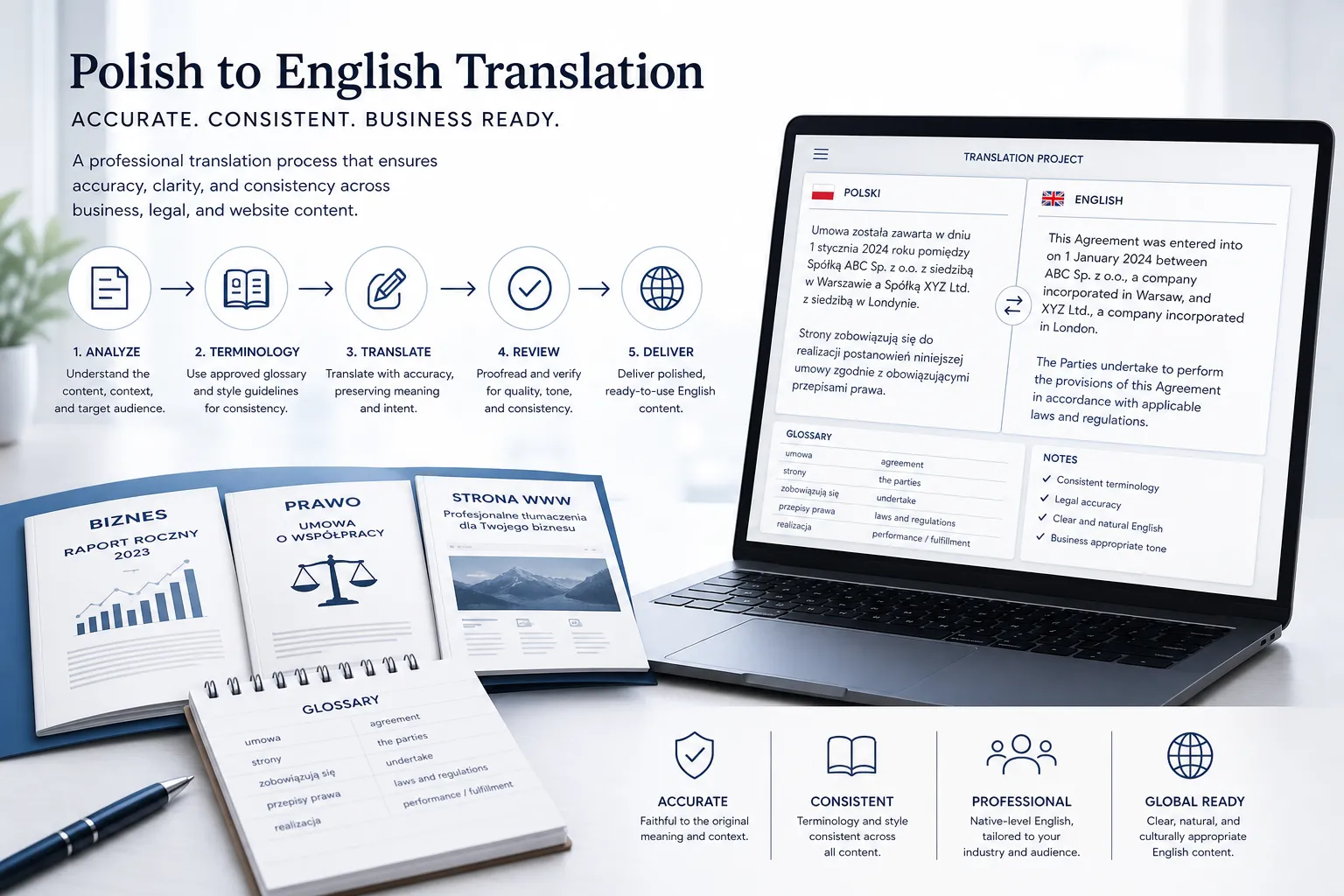
At Team Stream, we help organizations communicate clearly across languages with a blend of accurate human expertise and AI-powered efficiency. Whether you need written translation, interpreting, subtitling, voiceover, live captioning, or multilingual event support, the goal is the same: make communication understandable, inclusive, and reliable in every setting.
Why accuracy matters when translating Polish into English
Polish and English are structurally different languages. Polish uses complex case endings, flexible word order, grammatical gender, and formal/informal distinctions that do not always map neatly into English. As a result, literal translation often sounds awkward at best and misleading at worst.
A strong translation from Polish to English should do all of the following:
-
preserve the original meaning
-
reflect the correct tone and level of formality
-
use natural English syntax
-
maintain industry terminology
-
respect cultural and business context
-
stay consistent across documents and channels
This is especially important when the audience includes customers, employees, legal stakeholders, attendees, regulators, or multilingual event participants.
“A 2025 study by the European Commission found that 59% of web users prefer content in their most preferred language for web browsing – usually their native language.” – European Commission
That preference is not just about convenience. It directly affects comprehension, trust, and conversion.
Common challenges in translation from Polish to English
Many high-ranking translation pages focus on tools, features, or generic convenience. What they often miss is the practical complexity behind accurate language transfer. Here are the issues that most often affect quality.
Grammar and sentence structure
Polish allows more flexible word order than English because grammatical endings carry meaning. English depends much more heavily on word order. A direct transfer can produce a sentence that is technically understandable but unnatural or ambiguous.
False friends and misleading equivalents
Some Polish words look or sound similar to English terms but carry different meanings in real use. Business, legal, and technical language is especially vulnerable to this problem.
Formality and tone
Polish communication often signals politeness, hierarchy, or institutional formality differently than English does. In English, especially American business English, overly literal formality may sound stiff or outdated. In legal contexts, however, a formal register may need to be preserved carefully.
Industry terminology
A translator needs more than language ability. They need subject-matter familiarity. Legal clauses, healthcare forms, manufacturing instructions, trade show materials, church communications, and marketing campaigns all require domain-specific handling.
Website and UX localization
Buttons, menus, product descriptions, forms, metadata, and SEO language often need adaptation, not just translation. Content must fit the interface and sound natural to the intended audience.
When machine translation is enough – and when it is not
Free tools can be useful, but they are not a one-size-fits-all solution. The best choice depends on what is at stake.
Good use cases for AI or free tools
Machine translation can be helpful for:
-
getting the gist of informal content
-
understanding short personal messages
-
drafting internal notes
-
reviewing non-sensitive content quickly
-
generating a first pass for later human editing
When professional translation is needed
You should not rely on raw machine translation for:
-
contracts and legal notices
-
HR documents and employee policies
-
healthcare or compliance-related materials
-
public-facing web content
-
marketing campaigns
-
investor or board communications
-
subtitles, captions, and accessibility materials
-
event signage, agendas, and multilingual attendee communications
The higher the visibility, risk, or need for nuance, the more valuable professional review becomes.
Best ways to translate Polish to English accurately
A reliable process matters as much as linguistic skill. Here is what a high-quality workflow should include.
1. Start with the content purpose
Before translating, define the outcome. Is the text meant to inform, persuade, instruct, protect legally, or support accessibility? A press release, a contract, and a landing page should not be translated the same way.
2. Identify the audience
Are you writing for U.S. customers, UK partners, event attendees, employees, legal counsel, or multilingual worship audiences? Audience expectations affect terminology, tone, formatting, and even spelling conventions.
3. Build a terminology plan
Glossaries prevent inconsistency. This is vital for recurring terms such as product names, legal concepts, branded language, session titles, technical components, or church ministry terms.
4. Use human review for sensitive content
AI can accelerate first drafts, but professional linguists should review anything high stakes. Team Stream often supports this hybrid model, combining speed and scale with experienced human oversight.
5. Localize, do not just translate
Localization means adapting content for the target culture and use case. That could include changing examples, shortening headlines, adjusting navigation labels, or rewriting CTAs so they sound natural in English.
6. Test the final content in context
Translation quality should be checked where the text will actually appear: on a website, in slides, on event screens, in subtitles, in printed materials, or inside registration flows.
Polish to English translation for legal documents
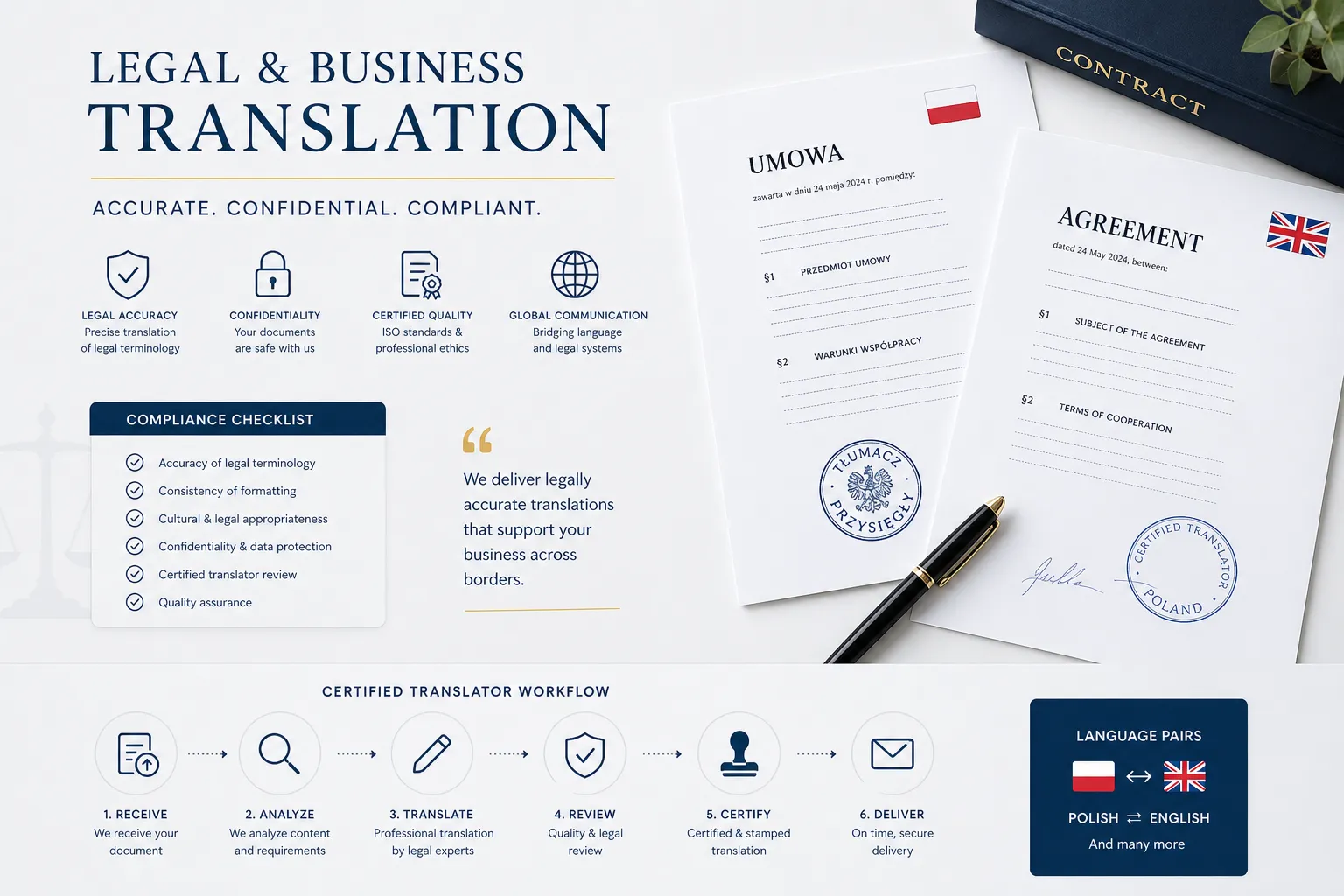
Legal translation is one of the clearest examples of why accuracy is non-negotiable. Polish legal language contains terms, references, and constructions that cannot be translated casually.
What legal translation often includes
-
contracts and agreements
-
NDAs
-
court or evidentiary documents
-
compliance policies
-
immigration paperwork
-
employment documents
-
terms and conditions
-
privacy notices
What can go wrong
A mistranslated clause may alter obligations, weaken enforceability, or create confusion around deadlines, liabilities, or jurisdiction. Literal rendering can also obscure meaning if the underlying legal systems frame concepts differently.
What to look for in a provider
For legal work, you need:
|
Requirement |
Why it matters |
|---|---|
|
Subject-matter familiarity |
Legal vocabulary requires precision beyond general fluency |
|
Consistent terminology |
Repeated clauses and concepts must remain uniform |
|
Confidential handling |
Sensitive content must be protected |
|
Human quality control |
Critical text needs expert review |
|
Formatting retention |
Legal structure and reference integrity matter |
Team Stream supports compliance-friendly language services designed for organizations that need clarity, confidentiality, and dependable execution.
Business translation: getting the message right, not just the words
Business communication often fails in translation because the original intent gets flattened. A word-for-word rendering may be understandable, but it may not persuade, reassure, or inform effectively.
Business content that often needs translation
-
emails and executive messages
-
internal communications
-
HR and onboarding content
-
sales collateral
-
presentations and speaker notes
-
proposals and reports
-
product sheets
-
training materials
Key priorities for business translation
Clarity
English business readers generally prefer concise, direct language. A strong translation trims unnecessary complexity while preserving meaning.
Tone
A formal Polish message may need to sound professional but approachable in English. This matters for customer service, B2B sales, executive communication, and event promotion.
Brand consistency
Your translated materials should still sound like your company. That is especially important for marketing teams and communications leaders managing multilingual brand presence.
Operational usability
Documents should be ready to use, not just linguistically correct. If a translated deck, script, caption file, or agenda needs heavy rework, the process has failed.
Website localization: how to translate website content from Polish to English
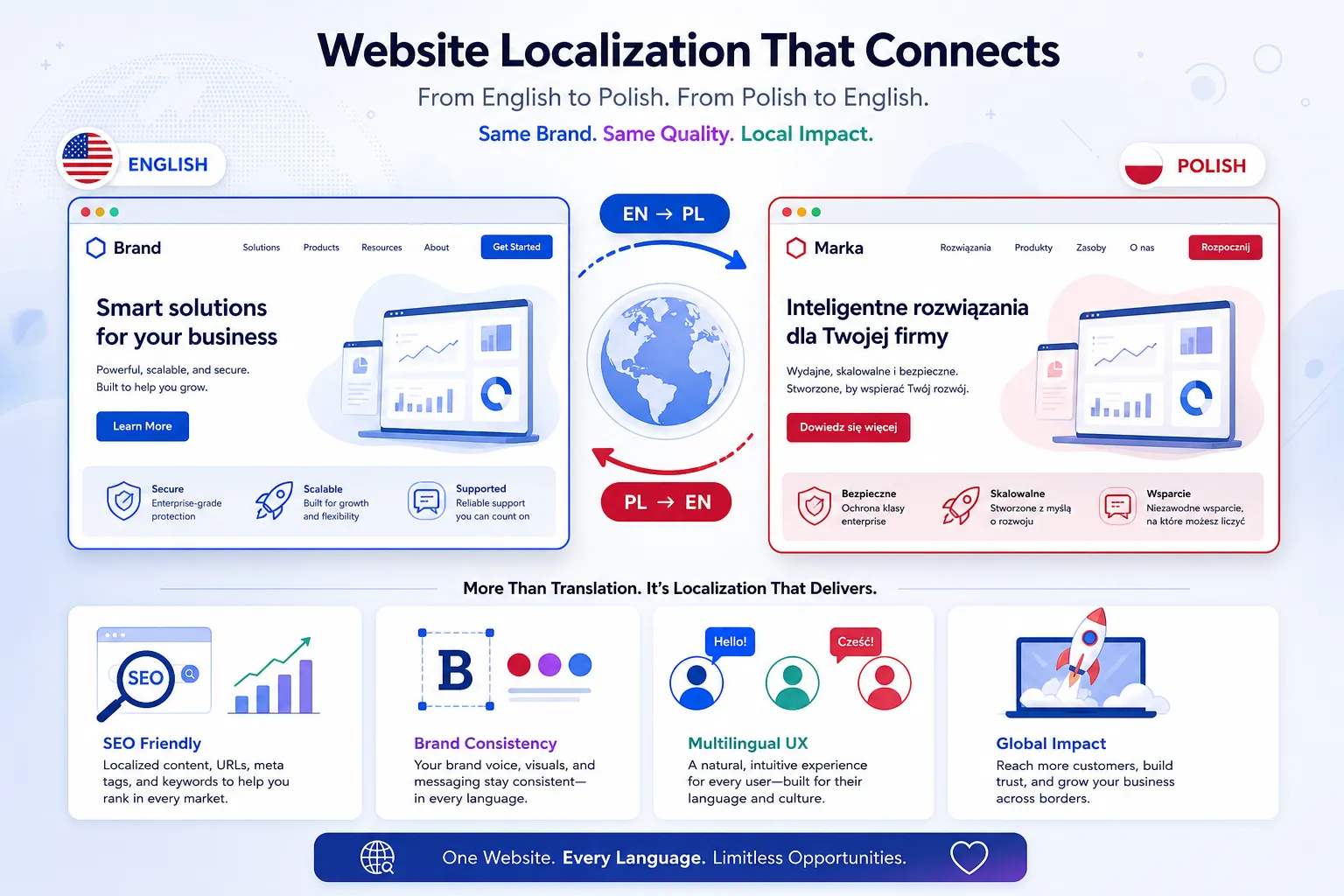
Website translation is not just page translation. It is a user experience project. Visitors judge clarity, trust, and professionalism within seconds.
What should be translated on a website
-
landing pages
-
service pages
-
product descriptions
-
navigation labels
-
forms and checkout flows
-
FAQs
-
help content
-
SEO metadata
-
downloadable documents
-
captions and transcripts for embedded media
What competitors often miss
Many pages talk about translating text, but they overlook:
-
search intent differences across languages
-
CTA adaptation
-
multilingual SEO structure
-
accessibility compliance
-
captioning and subtitling for media
-
consistency across downloadable assets and event microsites
Why this matters commercially
“A 2020 survey of 8,709 consumers across 29 countries revealed that 76% prefer purchasing products with information in their own language.” – CSA Research via Newswire
If you are expanding across markets, you should think in both directions: not only how to translate from Polish to English, but also when to translate to Polish for local customers, partners, employees, or attendees.
Why two-way communication matters: not just Polish to English, but English to Polish too
One of the biggest content gaps in typical translation articles is that they treat language as one-directional. Real organizations do not operate that way.
If your business works with Polish-speaking stakeholders, you may need to:
-
translate to Polish for outreach and onboarding
-
translate back into English for reporting and alignment
-
support bilingual events, meetings, and webinars
-
deliver captions, subtitles, or interpreting in both directions
-
maintain a consistent voice across both markets
This is particularly important for:
-
global conferences
-
church and ministry events
-
internal town halls
-
training programs
-
trade shows
-
product launches
-
multilingual broadcasts
-
cross-border HR and legal communications
Team Stream supports these environments with end-to-end language and accessibility solutions tailored to the format, audience, and level of risk.
Translation for live, virtual, and hybrid events

Translation is only one part of multilingual event communication. If your audience includes Polish and English speakers, you may also need interpreting, live captioning, subtitling, translated slides, or bilingual moderator support.
Services that often work together
|
Need |
Typical solution |
|---|---|
|
Live spoken communication |
Simultaneous or consecutive interpreting |
|
Accessibility for attendees |
Real-time captioning |
|
Recorded content |
Subtitling and transcripts |
|
Branded multilingual video |
Voiceover and translated captions |
|
On-site event support |
Equipment rental and technicians |
|
Hybrid audience language access |
Remote and in-person language delivery |
At Team Stream, this integrated model is a major advantage. Instead of sourcing translation, captioning, interpreting, equipment, and technical coordination from multiple vendors, organizations can work with one experienced partner.
That matters when timelines are tight and failure is visible.
“According to AudioEye’s 2026 Accessibility Advantage Report, 58% of business leaders view digital accessibility as a growth opportunity, reporting gains in traffic, conversions, and brand reputation.” – AudioEye
For conferences, webinars, broadcasts, and public-facing communications, accessible multilingual delivery is not just a compliance issue. It improves reach, understanding, and audience experience.
How to choose the right Polish translation partner
Not every provider is built for business-critical communication. Here is what to evaluate before you choose.
Quality assurance
Ask whether translations are reviewed by professionals and whether the provider uses glossaries, style guidance, and QA steps.
Specialization
A general translator may not be enough for legal, technical, event, ministry, or regulated content.
Accessibility capability
If your message also needs captions, subtitles, transcripts, or inclusive communication support, choose a partner that can handle the full picture.
Flexible delivery
Can they support in-person, remote, virtual, and hybrid workflows? Can they scale from one document to a full event?
Responsiveness
Deadlines matter. You want a provider with strong customer service, clear communication, and dependable turnaround.
Technical support
If your project includes live sessions, language feeds, or accessibility tools, technician support and equipment capability become major advantages.
Human translation vs AI-powered translation: a practical comparison
A smart content strategy usually is not human or AI. It is human plus AI used intentionally.
|
Factor |
AI-powered translation |
Human translation |
Best practice |
|---|---|---|---|
|
Speed |
Very fast |
Slower |
Use AI for first-pass speed |
|
Cost |
Lower upfront |
Higher upfront |
Reserve human review for high-value content |
|
Nuance |
Variable |
Strong |
Use humans for tone and meaning |
|
Legal reliability |
Limited |
High |
Always use human review |
|
Brand voice |
Inconsistent |
Stronger |
Use style guidance and editor review |
|
Scalability |
Excellent |
Moderate |
Combine both in a managed workflow |
Team Stream’s approach is built around this balance: use technology where it adds efficiency, and human expertise where it protects meaning, trust, accessibility, and quality.
A practical workflow for brands handling Polish and English content
If your organization regularly manages content in both languages, create a repeatable system.
Recommended workflow
-
Classify content by risk: casual, operational, public-facing, legal, or accessibility-critical.
-
Decide where AI can assist and where human review is required.
-
Build a bilingual glossary for names, offers, titles, and recurring terminology.
-
Localize website and campaign copy for the audience, not just the language.
-
Add captions, subtitles, or interpreting for live and recorded experiences.
-
Review final content in context before publishing or presenting.
-
Keep one partner accountable for consistency across channels where possible.
This reduces rework and helps teams move faster without sacrificing quality.
Final verdict: how to translate from Polish to English with confidence
If you only need the basic meaning of a short message, a free tool may be enough. But if the content affects your brand, legal standing, audience understanding, conversion rates, or accessibility obligations, professional support is the safer and smarter choice.
The most accurate translation from Polish to English comes from a process that combines language expertise, contextual judgment, terminology control, and delivery experience. And when your communication extends beyond documents into websites, meetings, videos, and events, you need more than a translator. You need a partner.
Team Stream brings together human and AI-powered translation, interpreting, captioning, subtitling, voiceover, equipment support, and technician services to help organizations communicate clearly in live, virtual, and hybrid environments. With more than 25 years of experience, flexible delivery options, and a strong commitment to inclusive, compliance-friendly communication, Team Stream helps you reach every audience with confidence.
If your team needs accurate Polish translation, bilingual event support, or a complete language access strategy, now is the time to build it with a partner that can execute at a high level from start to finish.
FAQ
How to translate Polish text to English?
Start by identifying the purpose, audience, and risk level of the content. For casual text, an online tool may help, but for business, legal, website, or event materials, use professional Polish to English translation with human review to preserve meaning and tone.
What is the best translator from Polish to English?
The best option depends on the content. For quick understanding, AI tools can help, but for accurate, client-facing, legal, or branded communication, a professional language partner like Team Stream offers better quality, consistency, and contextual accuracy.
What is the free app to translate Polish to English?
Several free apps can translate Polish to English, including common machine translation platforms. They are useful for simple, low-risk content, but they should not be the final solution for contracts, websites, accessibility materials, or important business communication.
Is Polish Google Translate accurate?
It can be helpful for basic understanding, but its accuracy varies depending on grammar, context, terminology, and tone. For sensitive or public-facing content, human review is strongly recommended to avoid errors and unnatural phrasing.
What is the best translator from Polish to English?
For professional results, the best translator is one that combines language expertise, subject knowledge, and quality control. Team Stream is especially valuable when your needs extend beyond documents into interpreting, captioning, subtitling, and multilingual event support.
How can I translate Polish to English online for free?
You can use a free online translator by pasting text into a web-based tool. This works best for short, informal, non-sensitive content; for accurate business, legal, or website translation, professional review is the better choice.
