

Farsi Translator: What Businesses Need in 2026
If your organization needs to communicate clearly with Persian-speaking audiences in 2026, choosing the right Farsi translator is no longer a nice-to-have. It affects trust, compliance, accessibility, brand reputation, and whether your message actually lands the way you intended.
For event organizers, internal communications teams, conference producers, marketers, healthcare organizations, churches, and corporate operations leaders, the challenge is rarely just “get this translated.” The real challenge is finding language support that is accurate, culturally aware, fast, and adaptable across live events, documents, video, captions, websites, and hybrid experiences.
A strong Farsi language translator helps you do more than convert words. They help you protect meaning, avoid costly misunderstandings, and create inclusive communication for audiences who expect clarity and professionalism. That matters even more now that businesses are blending human expertise with AI-powered workflows and serving multilingual audiences across more channels than ever.
Why Farsi Translation Matters More for Businesses in 2026
The business case for Persian language support is stronger than ever. Organizations are communicating across live meetings, webinars, trade shows, multilingual video, internal training, social content, and customer-facing documentation. In all of those settings, quality matters.
“As of March 29, 2026, according to ZipRecruiter, the average annual salary for a Farsi Translator in the United States is $57,200, which equates to approximately $27.50 per hour.” – ZipRecruiter
That figure reflects ongoing demand, but demand alone is not the whole story. The bigger issue is audience access.
“In the United States, approximately 27.3 million individuals aged five and older have limited English proficiency (LEP), representing about 9% of the population.” – KFF
For businesses and institutions, that means language access has become an operational priority. If you are hosting events, publishing policies, onboarding employees, or sharing important information, you need communication that reaches people clearly and inclusively.
What a Farsi Translator Actually Does
A professional Farsi translator works with written content, but the role often overlaps with broader multilingual communication support.
Core responsibilities
A qualified professional may handle:
-
Written translation from English to Farsi or Farsi to English
-
Review and editing for accuracy, tone, and terminology
-
Localization for culture, audience, and region
-
Subtitling and script adaptation for video
-
Quality control of AI-assisted drafts
-
Glossary and terminology management
-
Compliance-sensitive translation for legal, medical, HR, and public-facing content
Translation vs. interpretation
Businesses often confuse these two services. They are related, but they are not interchangeable.
|
Service |
What it covers |
Best for |
|---|---|---|
|
Translation |
Written content |
Documents, websites, manuals, subtitles, policies |
|
Interpretation |
Spoken communication in real time |
Meetings, conferences, webinars, interviews, live events |
|
Captioning |
On-screen text for spoken content |
Accessibility, engagement, compliance |
|
Localization |
Cultural and contextual adaptation |
Marketing, websites, campaigns, user experience |
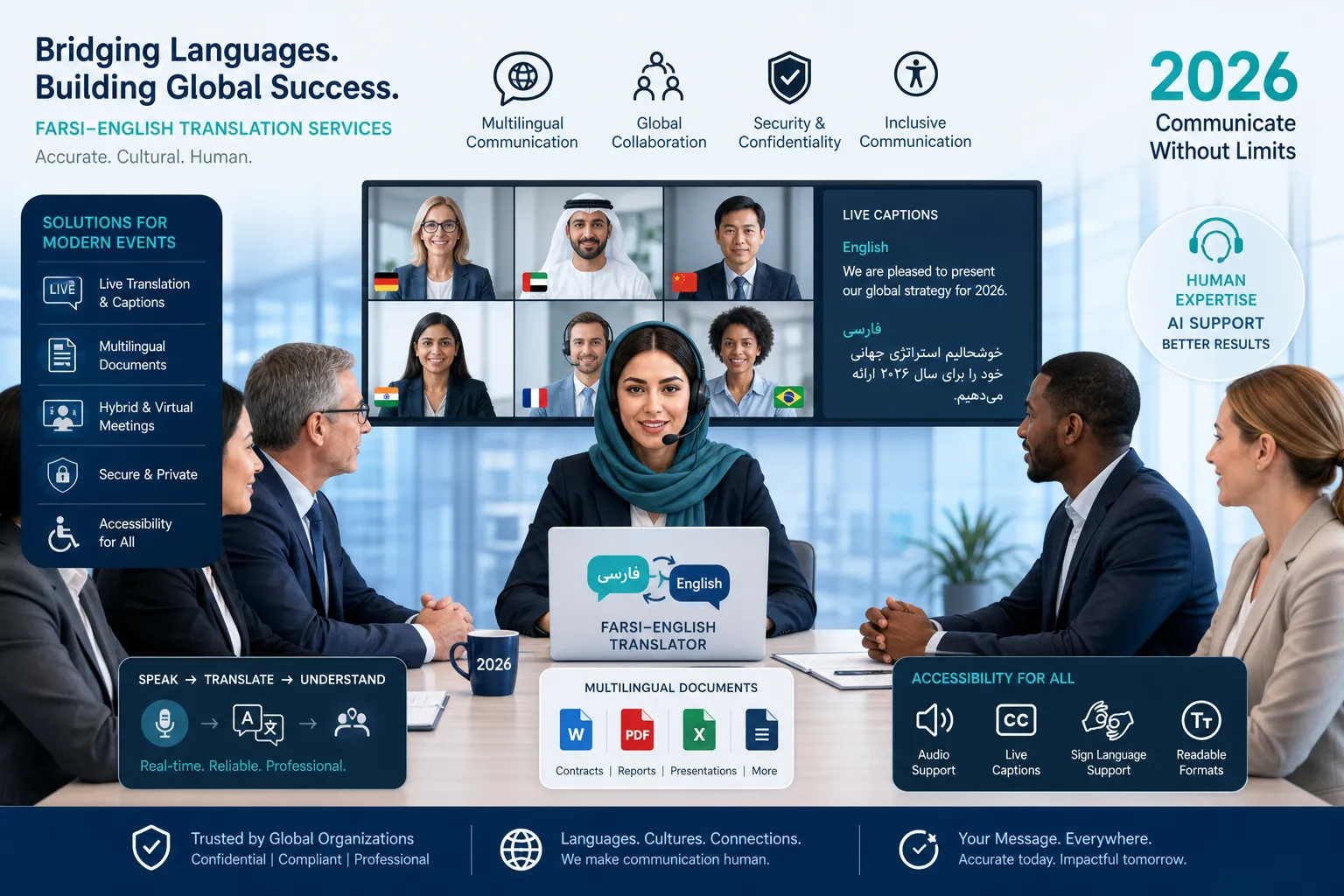
If your project involves a live multilingual audience, you may need more than translation alone. Team Stream frequently supports clients with integrated solutions that combine translation, interpreting, live captioning, subtitling, technician support, and event delivery for in-person, virtual, and hybrid formats.
Farsi, Persian, and Regional Nuance: What Businesses Should Know
Many buyers use “Farsi” and “Persian” interchangeably, and in most business settings that is acceptable. But a professional should still understand the nuance.
Farsi and Persian are usually the same language in business use
“Farsi” is the native name commonly used for Persian as spoken in Iran. In English-language business communication, “Persian” is often used more formally, while “Farsi” is widely recognized in search and service inquiries.
Regional differences still matter
A business-ready linguist should know when vocabulary, tone, or formatting may differ across:
-
Iran
-
Afghanistan, where Dari is used
-
Tajik-speaking contexts
-
Diaspora communities in North America and Europe
This matters for audience trust. A direct, literal translation may be technically understandable and still feel unnatural or off-brand to the intended reader.
The Most Common Business Use Cases for Farsi Translation
Competitor content often focuses heavily on jobs and general translation definitions. What it tends to miss is how organizations actually use these services in day-to-day operations. That is where buying decisions are made.
Corporate communications
Companies often need translation for:
-
Employee handbooks
-
Training materials
-
Benefits information
-
Internal announcements
-
Executive communications
-
Policy updates
If your workforce includes Persian-speaking employees or stakeholders, clarity supports both engagement and compliance.
Events, conferences, and trade shows
For live events, translation often expands into broader language access support:
-
On-site or remote Farsi interpreters
-
Live captioning for accessibility
-
Multilingual presentation support
-
Subtitled video assets
-
Interpreter audio equipment
-
Technician-managed setups for hybrid events
This is one of the biggest gaps in competitor coverage. Many businesses do not need a standalone translator. They need a coordinated event language solution. Team Stream is built for exactly that, combining human expertise, AI-enabled efficiency, accessibility services, equipment rental, and hands-on technical execution.
Marketing and brand content
Marketing translation is not just about replacing English words with Persian words. It requires:
-
Tone adaptation
-
Audience-specific phrasing
-
Cultural sensitivity
-
Calls to action that still feel persuasive
-
Localized product descriptions and landing pages
Poor marketing translation can make a brand sound careless. Good localization makes it feel intentional and credible.
Healthcare and patient communication
Healthcare content often involves high-risk material such as:
-
Intake forms
-
Patient instructions
-
Consent documents
-
Discharge paperwork
-
Educational brochures
-
Telehealth communication support
Accuracy here is essential. So is accessibility. Many organizations now pair translation with captioning and interpreting to support patients and families across multiple communication channels.
Legal and regulated content
Legal translation requires precision, consistency, and documented quality control. Common materials include:
-
Contracts
-
Declarations
-
Compliance notices
-
Court-related materials
-
Case summaries
-
Immigration documentation
A linguist who understands industry terminology is far more valuable than a generalist in these settings.
Media, video, and broadcast
Video continues to be a major growth area. Businesses increasingly need:
-
Farsi subtitles
-
Voiceover scripts
-
Closed captions
-
Broadcast interpreting support
-
Live multilingual streaming support
For churches, media teams, and event producers, this is especially important. Team Stream’s blend of captioning, interpreting, subtitling, and production support makes it easier to keep multilingual communication smooth across live and recorded content.
What to Look for When Hiring a Farsi Translator
The best choice is not simply the lowest rate or fastest turnaround. It is the provider that can match your risk level, audience needs, and delivery format.
1. Native-level fluency and cultural competence
A translator should understand not just vocabulary, but register, audience expectations, and cultural implications. This is critical for marketing, leadership messaging, legal language, and public communications.
2. Subject-matter expertise
Ask whether the linguist has relevant experience in your field:
-
Healthcare
-
Legal
-
Corporate HR
-
Government
-
Education
-
Live events
-
Media production
Industry familiarity improves speed and reduces revision cycles.
3. Quality assurance process
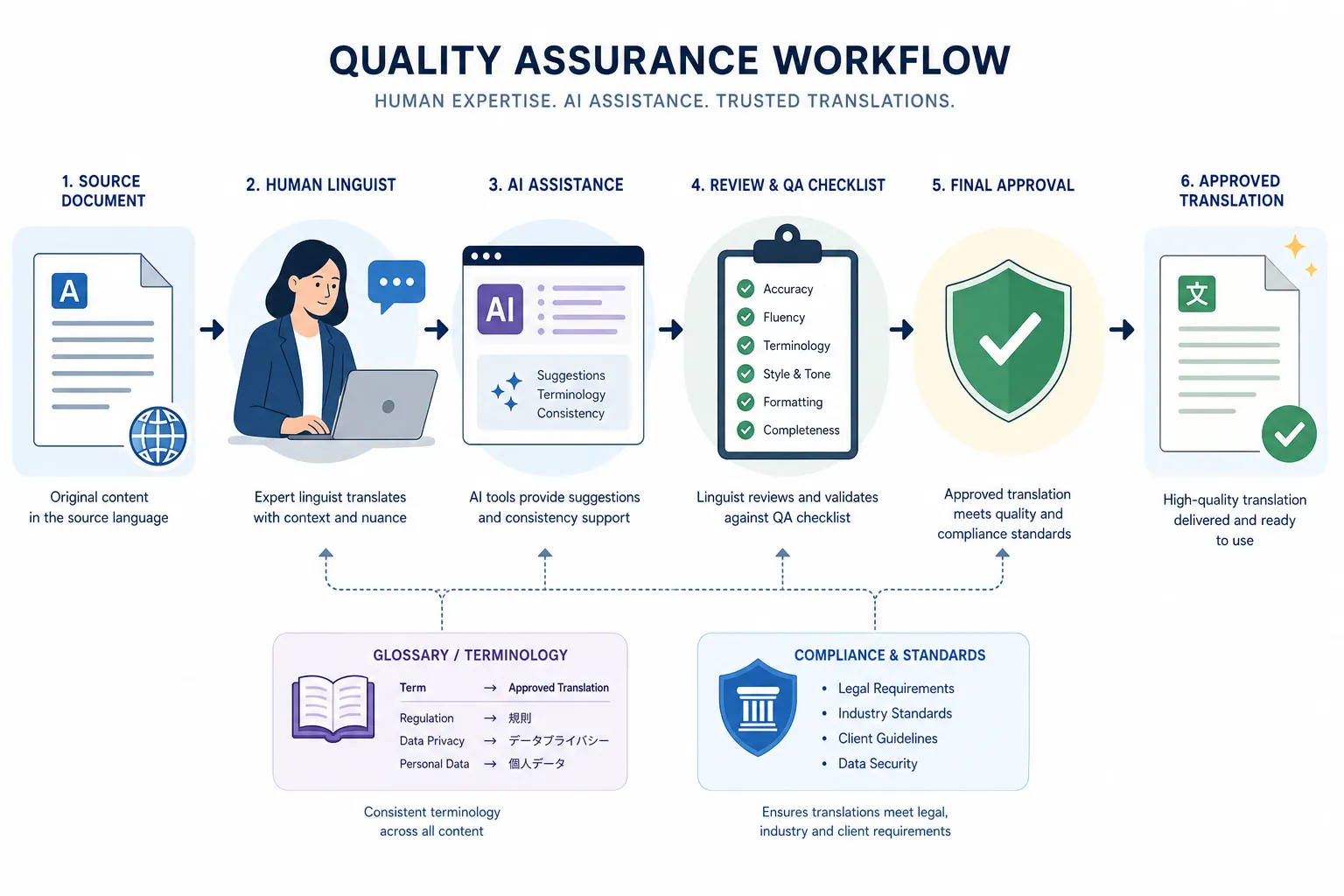
A professional workflow should include more than one pass. Look for:
-
Translation
-
Editing
-
Proofreading
-
Terminology review
-
Final QA
-
Optional client glossary alignment
4. Human plus AI capability
In 2026, the question is not whether AI is involved. The question is whether it is used responsibly.
A modern provider should know when AI can improve speed and scalability, and when human review must lead. That is especially important for sensitive, branded, or high-stakes communication. Team Stream’s approach is valuable here: accurate human and AI-powered translation and interpreting, tailored to the client’s workflow rather than forced into a one-size-fits-all model.
5. Accessibility and compliance awareness
Many competitor pages overlook this completely. If your content is public-facing, event-based, educational, or organizationally important, translation may need to align with accessibility goals and regulatory expectations.
That may include:
-
Closed captioning
-
Real-time captioning
-
Accessible video workflows
-
Inclusive event design
-
Language support for live and remote participants
6. Delivery flexibility
Businesses today need options. The right partner should support:
-
In-person delivery
-
Remote delivery
-
Hybrid events
-
Fast-turn documents
-
Ongoing multilingual workflows
-
Managed event support with technicians and equipment
Red Flags That Signal a Poor Translation Partner
Not every provider is ready for business-critical Farsi work. Be cautious if you notice any of the following:
Overreliance on raw machine output
If a provider cannot explain their review process, assume risk. Literal machine translation can distort tone, terminology, and meaning.
No experience with live communication
If your needs include events, interviews, webinars, or executive sessions, written translation alone will not cover it.
No terminology management
Without glossaries, style guides, and approved phrasing, consistency breaks down across documents and teams.
No accessibility support
If your provider handles words but not audience access, you may end up coordinating multiple vendors for translation, captioning, subtitling, and event delivery. That creates friction and raises the chance of errors.
Vague turnaround promises
Serious providers give realistic timelines based on content type, volume, complexity, and review needs.
How AI Is Changing Farsi Translation in 2026
AI has changed translation workflows, but it has not eliminated the need for experts. In fact, it has made expertise more important.
Where AI helps
AI can support:
-
First-pass drafting
-
Terminology suggestions
-
Repetitive content
-
Large-scale document processing
-
Faster turnaround on lower-risk material
Where human review remains essential
Human linguists are still critical for:
-
Tone and nuance
-
Brand voice
-
Legal and medical accuracy
-
Sensitive communications
-
Event interpreting
-
Cultural adaptation
-
Final QA and accountability
For businesses, the smartest approach is not human versus AI. It is a managed combination of both. Team Stream is especially strong in this area because it combines professional human delivery with AI-enabled efficiency, while keeping quality, accessibility, and responsiveness at the center.
How Translation Supports Accessibility, Inclusion, and Reach
This is another area where many competitor pages underdeliver. They talk about language, but not enough about audience experience.
Accessibility is bigger than translation alone
If you are hosting a multilingual event or publishing video, your audience may need:
-
Translation for documents and scripts
-
Interpreting for live speech
-
Real-time captions for comprehension and accessibility
-
Subtitles for recorded content
-
Technician support to ensure the experience works in practice
For event organizers and corporate teams, these services should work together, not in silos.
Better access leads to better engagement
When people can understand your message in real time and in the right format, they are more likely to:
-
Stay engaged
-
Trust the information
-
Take action
-
Participate confidently
-
View your organization as inclusive and professional
This is especially important in conferences, internal communications, faith-based programming, public information campaigns, and customer education.
A Practical Checklist for Businesses Evaluating Farsi Translation Support
Use this checklist before you hire a provider:
|
Question |
Why it matters |
|---|---|
|
Do they have native-level Farsi expertise? |
Prevents awkward or inaccurate phrasing |
|
Do they understand my industry? |
Reduces errors in technical content |
|
Can they support both documents and live communication? |
Helps unify your workflow |
|
Do they offer human-reviewed AI workflows? |
Improves speed without sacrificing quality |
|
Can they support accessibility needs? |
Protects inclusion and compliance goals |
|
Can they handle virtual, live, and hybrid delivery? |
Future-proofs your communications |
|
Do they provide equipment or technician support if needed? |
Simplifies event execution |
|
Are they responsive and service-oriented? |
Reduces stress and delays |
Why Businesses Choose a Full-Service Partner Instead of a Freelancer Alone
A freelancer can be a great fit for a simple document. But many organizations in 2026 need more than a single linguist.
They need a partner that can scale from one translated file to a full multilingual event environment with captions, interpreters, video accessibility, technician support, and flexible remote or in-person service delivery.
That is where Team Stream stands out.
What Team Stream brings to the table
Team Stream offers:
-
Accurate human and AI-powered translation and interpreting
-
Real-time captioning for accessibility and audience engagement
-
End-to-end language and accessibility solutions tailored to each client
-
Support for live, virtual, and hybrid events
-
Compliance-friendly services for inclusive communication
-
Professional equipment rental and technician support
-
Flexible in-person and remote delivery
-
More than 25 years of experience
-
Reliable execution backed by responsive customer service
For busy event producers, operations managers, communications leaders, and marketing teams, that means fewer vendors to manage and a much smoother path from planning to delivery.
Final Thoughts: What Businesses Really Need in 2026
A Farsi translator in 2026 should do more than convert text. The right provider helps your organization communicate accurately, respectfully, and accessibly across documents, events, media, and real-time interactions.
If your message matters, quality matters. And if your audience matters, accessibility matters too.
That is why many organizations are moving beyond narrow translation buying and choosing integrated language access partners instead. When you need Persian language support that works across live events, corporate communication, video, and inclusive audience experiences, Team Stream gives you the expertise, flexibility, and service depth to get it right the first time.
If you are planning a multilingual event, updating critical content, or expanding communication with Persian-speaking audiences, Team Stream is ready to help you deliver it clearly, professionally, and confidently.
FAQ
How much do Farsi translators make?
Pay varies by experience, specialization, and whether the work is freelance or full-time, but current market data shows many roles clustering around the mid-range of professional language services. A useful benchmark is that the average annual pay is about $57,200 in the U.S., with higher earnings possible in legal, medical, government, and highly specialized work.
Is there a future for translators?
Yes – especially for professionals who combine language expertise, cultural knowledge, and subject-matter specialization. AI is changing workflows, but businesses still need human-reviewed translation, live interpreting, accessibility support, and quality assurance for high-stakes communication.
What languages are in high demand for translators?
Demand is strongest for languages tied to global business, public services, healthcare, government, and multilingual communities, including Spanish, Arabic, Mandarin, Farsi/Persian, Dari, and other high-need languages. The highest-value work often comes from specialized sectors where accuracy and compliance matter most.
