

Simultaneous Interpretation Services Explained
When your event includes attendees who speak different languages, delays in communication are more than an inconvenience – they can damage engagement, reduce understanding, and make people feel excluded. That is why simultaneous interpretation services are so valuable for conferences, corporate meetings, trade shows, broadcasts, churches, and hybrid events. They allow participants to hear a message in their preferred language almost instantly, without interrupting the flow of the speaker.
For event organizers and communications teams, the challenge is not just translation. It is delivering a multilingual experience that feels seamless, professional, accessible, and reliable. That means getting the right interpreters, audio setup, workflow, accessibility support, and event technology in place from the start.
At Team Stream, we help organizations solve exactly that problem with accurate human interpreting, AI-powered language support, live captioning, accessibility services, equipment rental, and technician support for in-person, virtual, and hybrid events. With more than 25 years of experience, we know that successful multilingual communication depends on more than words alone – it depends on execution.
“Simultaneous interpreting is a mode of interpretation where the interpreter translates the speaker’s words into another language in real-time, as the speaker continues to speak.” – European Commission
What Are Simultaneous Interpretation Services?
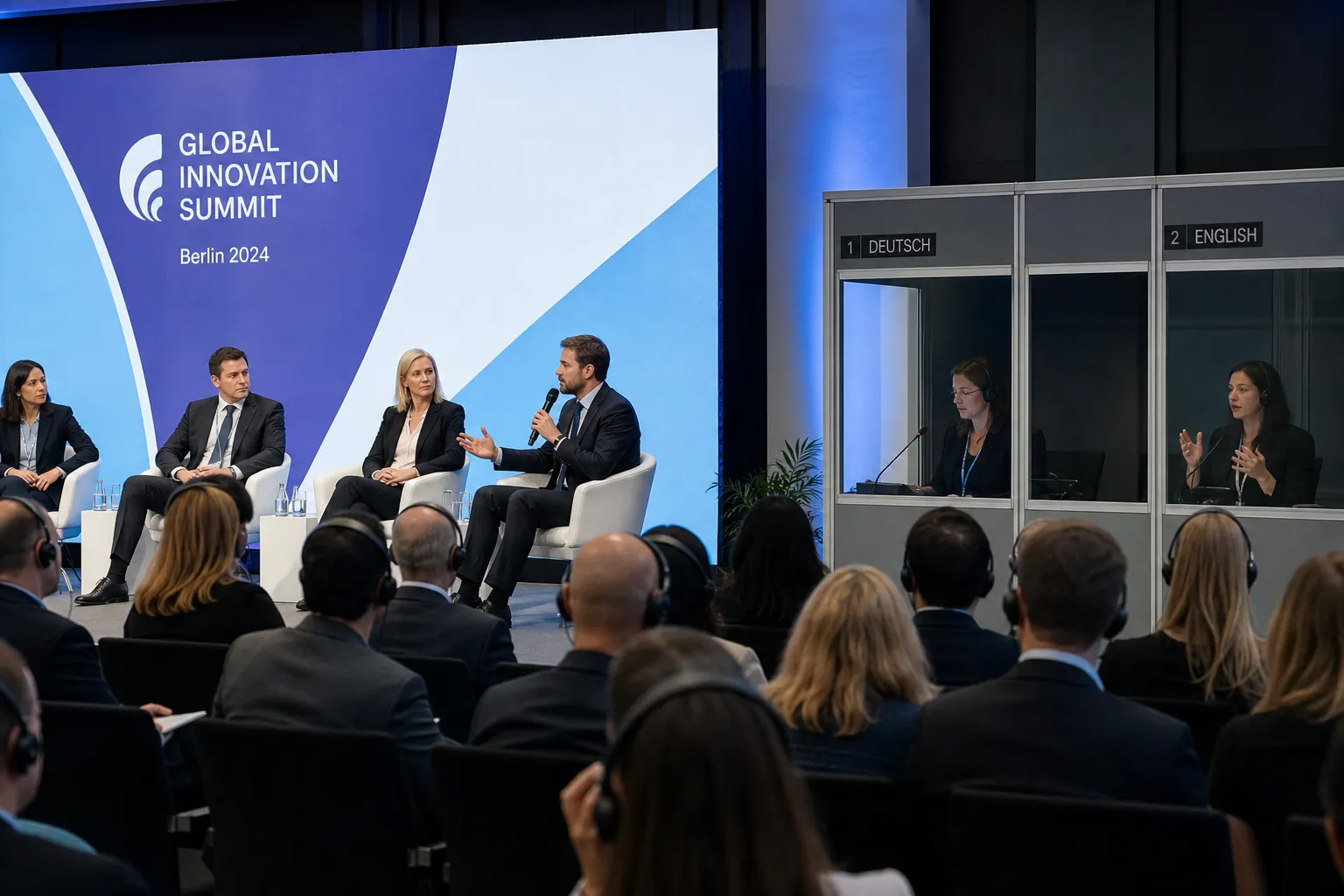
Simultaneous interpretation services convert spoken language into another language in real time while the speaker is still talking. Instead of waiting for pauses, the interpreter listens, processes meaning, and delivers the interpretation with only a brief delay.
This service is commonly used when the audience cannot afford interruptions, such as:
-
International conferences
-
Executive meetings
-
Trade shows and expos
-
Investor presentations
-
Government or diplomatic sessions
-
Church services and faith-based gatherings
-
Broadcasts and live-streamed events
-
Training sessions for multilingual teams
The biggest advantage is speed. The speaker continues naturally, and listeners follow along in their own language through headsets, event apps, streaming platforms, or audio channels.
How Simultaneous Interpretation Works
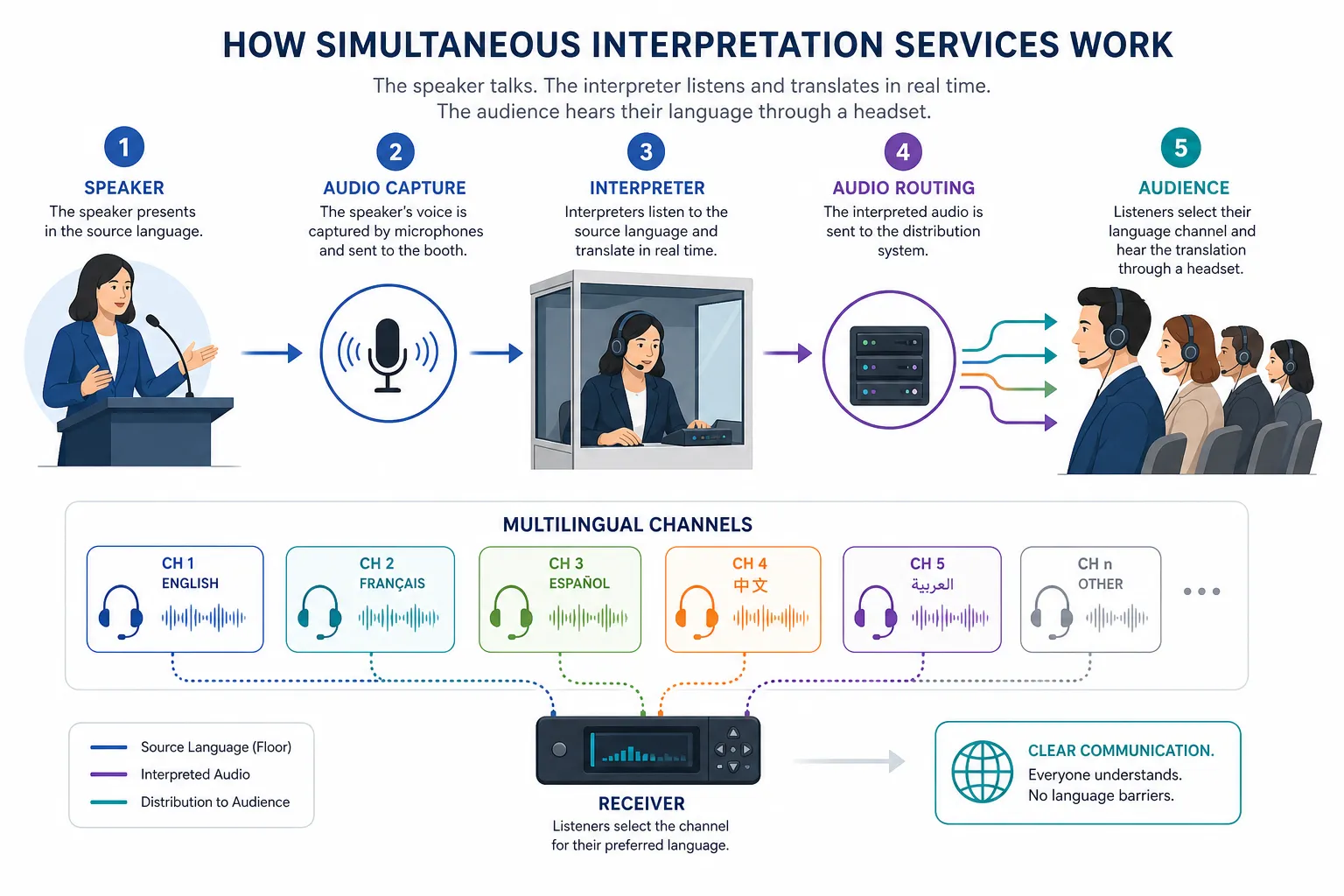
At a high level, the process is simple. In practice, it requires coordination, trained professionals, and dependable technology.
The basic workflow
-
A speaker talks in the source language.
-
The interpreter listens through a headset or audio feed.
-
The interpreter reformulates the message into the target language in near real time.
-
Attendees listen through headsets, mobile devices, or integrated virtual event channels.
What attendees experience
For the audience, a well-run simultaneous interpretation setup feels effortless. They choose their language channel and hear the interpretation almost immediately. The event continues at normal pace, which protects energy, timing, and audience engagement.
Why it is difficult
Simultaneous interpreting is one of the most demanding language tasks. The interpreter must:
-
Listen and understand in real time
-
Anticipate sentence structure and meaning
-
Retain names, numbers, and terminology
-
Speak clearly in the target language
-
Preserve tone, intent, and context
“Simultaneous interpreting is a cognitively demanding task that requires interpreters to listen, process, and translate speech in real-time.” – Seeber and Kerzel
That cognitive load is one reason professional simultaneous interpreters often work in teams and rotate throughout longer sessions.
Simultaneous vs. Consecutive Interpreting
Many buyers researching simultaneous interpretation services are also comparing them to consecutive interpreting. The right choice depends on your format, audience size, schedule, and goals.
|
Feature |
Simultaneous Interpreting |
Consecutive Interpreting |
|---|---|---|
|
Delivery style |
Interpreter speaks while speaker continues |
Interpreter speaks after the speaker pauses |
|
Event flow |
Fast and uninterrupted |
Slower and segmented |
|
Best for |
Conferences, keynotes, broadcasts, multilingual panels |
Small meetings, interviews, legal or medical conversations |
|
Audience size |
Medium to large groups |
Small groups or one-on-one settings |
|
Equipment needs |
Usually requires audio channels, headsets, platform integration |
Minimal equipment needed |
|
Overall experience |
More seamless for multilingual audiences |
More practical for smaller interactions |
If you are hosting a time-sensitive event with multiple languages and a larger audience, simultaneous interpretation services are usually the better fit.
When You Need Simultaneous Interpretation Services
Not every meeting needs real-time interpretation. But when communication speed, professionalism, and audience inclusion matter, simultaneous interpreting becomes essential.
Conferences and conventions
Large conferences often involve keynote speakers, breakout sessions, and global attendees. Simultaneous interpretation keeps the program moving and allows all participants to stay engaged without doubling session length.
Corporate meetings and town halls
Global companies use simultaneous interpretation for leadership updates, training, compliance briefings, earnings calls, and internal communications. It helps ensure employees receive the same message at the same time, regardless of language.
Trade shows and product launches
At trade shows, attention is limited. If multilingual attendees have to wait for translation, momentum is lost. Real-time interpretation helps brands communicate clearly and professionally in a busy, competitive environment.
Broadcasts and live streams
For live online content, timing matters even more. Simultaneous interpreting can be integrated into streaming workflows so remote viewers can select language channels while watching the event live.
Churches and faith-based events
Congregations are often multilingual and multigenerational. Simultaneous interpretation supports inclusion, participation, and accessibility without disrupting worship or programming.
Hybrid and virtual events
Remote audiences expect a smooth experience. Simultaneous interpreting supports multilingual engagement across platforms, making hybrid communication more equitable and effective.
The Key Benefits of Simultaneous Interpretation Services
1. Real-time multilingual communication
The most obvious benefit is speed. People hear the message right away, which keeps the event natural and efficient.
2. Better audience engagement
When attendees can follow the content comfortably in their own language, they are more likely to pay attention, participate, and retain information.
3. Stronger accessibility and inclusion
Language access is a core part of inclusion. For many organizations, it also intersects with accessibility, public service obligations, and compliance requirements. Pairing simultaneous interpretation with real-time captioning creates an even more inclusive experience for Deaf, hard-of-hearing, multilingual, and global audiences.
4. Professional event flow
Consecutive interpreting can double the length of a presentation. Simultaneous interpreting preserves your run of show and prevents fatigue for both speakers and listeners.
5. Global brand credibility
A multilingual event that runs smoothly sends a strong message: your organization is prepared, international, and serious about serving diverse audiences.
Types of Simultaneous Interpretation Setups
There is no one-size-fits-all model. The best setup depends on your venue, platform, audience, language count, and budget.
On-site simultaneous interpretation
This is the traditional setup used for conferences and live events. Interpreters work from booths or controlled audio environments, and attendees listen on receivers or headsets.
Best for:
-
In-person conferences
-
Trade shows
-
Corporate events
-
Large church gatherings
-
High-stakes multilingual presentations
Remote simultaneous interpretation
Interpreters work from a separate location and deliver language channels through cloud-based platforms. This is ideal for virtual events and can also support in-person audiences.
Best for:
-
Webinars
-
Virtual conferences
-
Remote meetings
-
Distributed teams
-
Cost-sensitive multilingual programs
Hybrid simultaneous interpretation
A hybrid setup supports both in-room and remote audiences. It requires careful planning because audio routing, platform integration, room acoustics, and technician oversight all matter.
Best for:
-
Hybrid conferences
-
Global all-hands meetings
-
Events with live and online attendees
-
Multi-location broadcasts
What Equipment Is Needed?
Many competitor articles mention booths and headsets, but they rarely explain how much the technical setup affects quality. In reality, the equipment is just as important as the interpreters.
Common components include
-
Interpreter booths or portable sound isolation
-
Interpreter consoles and microphones
-
Audio distribution systems
-
Audience headsets or receivers
-
Streaming or conferencing platform integration
-
Backup internet and audio routing for remote delivery
-
Technician support for monitoring and troubleshooting
For successful multilingual events, the technical chain must be stable from the speaker microphone all the way to the listener’s ear. That is why Team Stream offers not only interpreting services, but also professional equipment rental, sales, and technician support to ensure quality from end to end.
Human Interpreters vs. AI-Powered Language Support
Organizations increasingly ask whether AI can replace simultaneous interpretation services. The real answer is more nuanced.
Where human interpreters excel
Human interpreters are still the best choice when your event requires:
-
High accuracy
-
Nuance and tone preservation
-
Industry terminology
-
Sensitive or high-stakes communication
-
Live audience interaction
-
Cultural judgment and professionalism
Where AI can help
AI-powered tools can support multilingual access through:
-
Live translated captions
-
Fast multilingual audio support in some settings
-
Scalable access for large virtual audiences
-
Budget-friendly options for lower-risk scenarios
The best approach for many events
The strongest strategy is often a human-plus-technology model. Team Stream helps clients choose the right combination of human expertise and AI-enabled solutions based on the event’s goals, audience expectations, and compliance needs.
|
Need |
Human Interpreting |
AI-Powered Support |
Best Choice |
|---|---|---|---|
|
High-stakes executive communication |
Excellent |
Limited |
Human |
|
Large multilingual webinar |
Strong |
Strong |
Hybrid approach |
|
Accessibility with captions |
Strong with captioning team |
Strong |
Combined |
|
Sensitive legal or compliance content |
Excellent |
Riskier |
Human |
|
Budget-conscious internal update |
Good |
Useful |
Depends on stakes |
How Many Interpreters Do You Need?
This depends on:
-
Number of languages
-
Length of the session
-
Format of the event
-
Subject matter complexity
-
Number of simultaneous sessions or breakout rooms
As a general planning rule, longer sessions often require interpreter rotation because of the intense mental workload. If your event includes technical terminology, dense presentations, or multiple concurrent tracks, staffing needs increase.
A common mistake is underestimating this requirement. Cutting interpreter coverage too tightly can reduce quality. A better approach is to plan for performance, not just minimum cost.
What Drives the Cost of Simultaneous Interpretation Services?
Pricing varies widely, but the main cost drivers are consistent.
Primary pricing factors
-
Language pair and interpreter specialization
-
Number of languages needed
-
Event duration
-
On-site, remote, or hybrid delivery model
-
Equipment and audio distribution
-
Technician support
-
Preparation materials and terminology research
-
Travel and lodging for in-person assignments
-
Number of breakout rooms or parallel sessions
Why rates vary so much
A simple internal meeting with one language pair is not comparable to a three-day hybrid conference with captioning, multilingual streams, and technical support. Buyers should evaluate total event needs, not just the interpreter rate.
Cost vs. value
The right question is not only “What does simultaneous interpretation cost?” It is also “What does miscommunication cost?” Poor multilingual delivery can lead to confusion, audience drop-off, accessibility complaints, lower engagement, and reputational risk.
How to Prepare for a Successful Multilingual Event
One content gap in many competitor articles is event preparation. The quality of simultaneous interpretation improves dramatically when the event team prepares correctly.
Best practices before the event
-
Share slides, agendas, names, and terminology in advance
-
Confirm language channels early
-
Identify whether captioning is also needed
-
Test audio, microphones, and platform routing
-
Decide how virtual attendees will access language channels
-
Assign a technical point of contact
-
Build multilingual instructions into the attendee experience
Best practices during the event
-
Use quality microphones
-
Ask speakers to avoid talking over each other
-
Keep interpreters informed of schedule changes
-
Monitor sound quality continuously
-
Provide support for audience headset or language-channel questions
Best practices after the event
-
Review audience feedback
-
Assess language usage by session
-
Save glossaries and terminology for future events
-
Refine the workflow for recurring multilingual programs
Simultaneous Interpretation and Accessibility
Language access and accessibility often belong in the same event strategy, but many organizations treat them separately. That is a missed opportunity.
A more inclusive event may combine:
-
Simultaneous interpretation
-
CART or live captioning
-
Closed captioning for streamed content
-
Subtitling for on-demand replay
-
ASL interpreting where needed
-
Accessible audio and visual workflows
Team Stream is built around this broader view. We support clients with language services and accessibility solutions together, helping them create events, meetings, videos, and broadcasts that are more compliant, more inclusive, and more effective.
Choosing the Right Simultaneous Interpretation Partner
Not all providers offer the same level of support. Some only supply interpreters. Others leave you to figure out platforms, equipment, or audience access on your own.
A strong partner should help with:
|
What to look for |
Why it matters |
|---|---|
|
Experienced interpreters |
Protects accuracy, professionalism, and credibility |
|
Technology options |
Supports in-person, virtual, and hybrid delivery |
|
Accessibility services |
Helps create a more inclusive and compliant event |
|
Equipment and technicians |
Reduces operational risk |
|
Flexible service models |
Matches your event size, format, and budget |
|
Responsive project management |
Prevents last-minute confusion |
|
Preparation support |
Improves interpreting quality |
With Team Stream, clients get a partner that can support the full multilingual event lifecycle – from interpreting and live captioning to translation, subtitling, technician support, and equipment logistics. That means fewer vendors, smoother planning, and better execution.
Why Team Stream Is a Strong Fit for Simultaneous Interpretation Services
Organizations choose Team Stream because they need more than a vendor. They need a reliable partner that understands language access, accessibility, event production, and audience experience.
What sets Team Stream apart
-
Over 25 years of expertise
-
Accurate human interpreting and flexible AI-powered language solutions
-
Live, virtual, and hybrid event support
-
Real-time captioning for accessibility and engagement
-
Translation, subtitling, and voiceover services
-
Compliance-friendly solutions for inclusive communication
-
Equipment rental, sales, and technician support
-
Tailored service plans instead of one-size-fits-all packages
-
Responsive customer service and dependable execution
For event organizers, operations teams, internal communications leaders, and producers, that full-service model simplifies multilingual planning and improves results.
Final Thoughts
Simultaneous interpretation services are not just about translating speech quickly. They are about making communication work in real time for everyone in the room – or everyone watching remotely. When done well, they improve engagement, preserve event flow, support accessibility, and help organizations communicate with confidence across languages.
If your event, meeting, broadcast, or internal communication program needs to reach multilingual audiences without compromise, Team Stream can help you build the right solution. From expert interpreters and captioning professionals to AI-enabled options, equipment, and technical support, we deliver language access and accessibility services designed to perform in the real world.
If you want a multilingual event experience that is clear, inclusive, and professionally executed, Team Stream is ready to help.
FAQ
How does simultaneous interpretation work?
Simultaneous interpretation happens when an interpreter listens to a speaker and delivers the message in another language almost instantly. Attendees hear the translated audio through headsets, receivers, apps, or virtual event channels without interrupting the speaker.
What is the hourly rate for simultaneous interpreting?
The hourly rate varies based on language pair, subject complexity, event format, interpreter experience, and technical requirements. For accurate pricing, it is best to request a custom quote that also accounts for equipment, technician support, and any hybrid or remote setup needs.
What are the 4 types of interpretation?
The four commonly referenced types are simultaneous, consecutive, whispered interpretation, and sight translation. Each serves different use cases depending on the event format, audience size, and communication goals.
How much should I charge for simultaneous interpretation?
If you are pricing simultaneous interpretation, your rate should reflect language expertise, specialization, preparation time, delivery format, and equipment or travel needs. For buyers, value matters more than the lowest fee because quality and reliability directly affect the audience experience.
What is the hourly rate for simultaneous interpreting?
There is no single universal hourly rate because simultaneous interpreting is usually priced according to scope, language count, event duration, and service model. In many cases, total project cost matters more than the hourly figure alone.
What are the 4 types of interpretation?
The main types are simultaneous interpreting, consecutive interpreting, whispered interpreting, and sight translation. The right option depends on whether you need real-time multilingual delivery, small-group support, or quick oral rendering of written content.
